
When maintenance, inspection, or system work is required, a reliable method of isolating high-voltage electrical systems is paramount. This isolation is provided by mechanical separation between a circuit/ piece of equipment and it power source with the help of a high-voltage disconnect switch.
Select an industrial or mining disconnect beyond the voltage rating. Engineers and facility operators also want to reflect on the present needs that influence load interruption, fuse protection, control functions like switching and monitoring, equipment configuration, extent of value addition provided by the switch in the overall electrical distribution system.
Years of experience at Becker/SMC have long been designing and manufacturing electrical components and power distribution equipment for demanding applications. We offer a wide range of electrical control and distribution products such as high-voltage disconnects.
Key Takeaways
- A high-voltage disconnect switch isolates electrical equipment from its power source and can provide a clear means of circuit separation.
- Disconnect switches and circuit breakers do not necessarily perform the same job; the switching duty must match the application.
- Becker/SMC offers visible disconnect switches rated through 15 kV for non-load-break applications.
- Available Becker/SMC configurations can incorporate auxiliary switches, fuseholders, and trip-related devices.
- Selecting a supplier should involve both individual switch specifications and how the disconnect will interact with the rest of the electrical system.
- Becker/SMC designs and manufactures electrical equipment from its Bristol, Virginia operation.
What Is a High Voltage Disconnect Switch?
A high voltage disconnect switch is a mechanical switching device used to isolate a circuit or electrical equipment from its power source.
OSHA defines a disconnecting or isolating switch for systems over 600 volts as a mechanical switching device used for this isolation function.
The key word is isolation.
When opened in an appropriate system configuration, a visible disconnect can establish a physical separation in the electrical path. This makes disconnects an important part of electrical distribution systems where equipment must be isolated for servicing or other work.
However, a disconnect switch should not automatically be treated as a circuit breaker. The device's switching capabilities and ratings determine what it can safely do.
How Does a High Voltage Disconnect Switch Work?
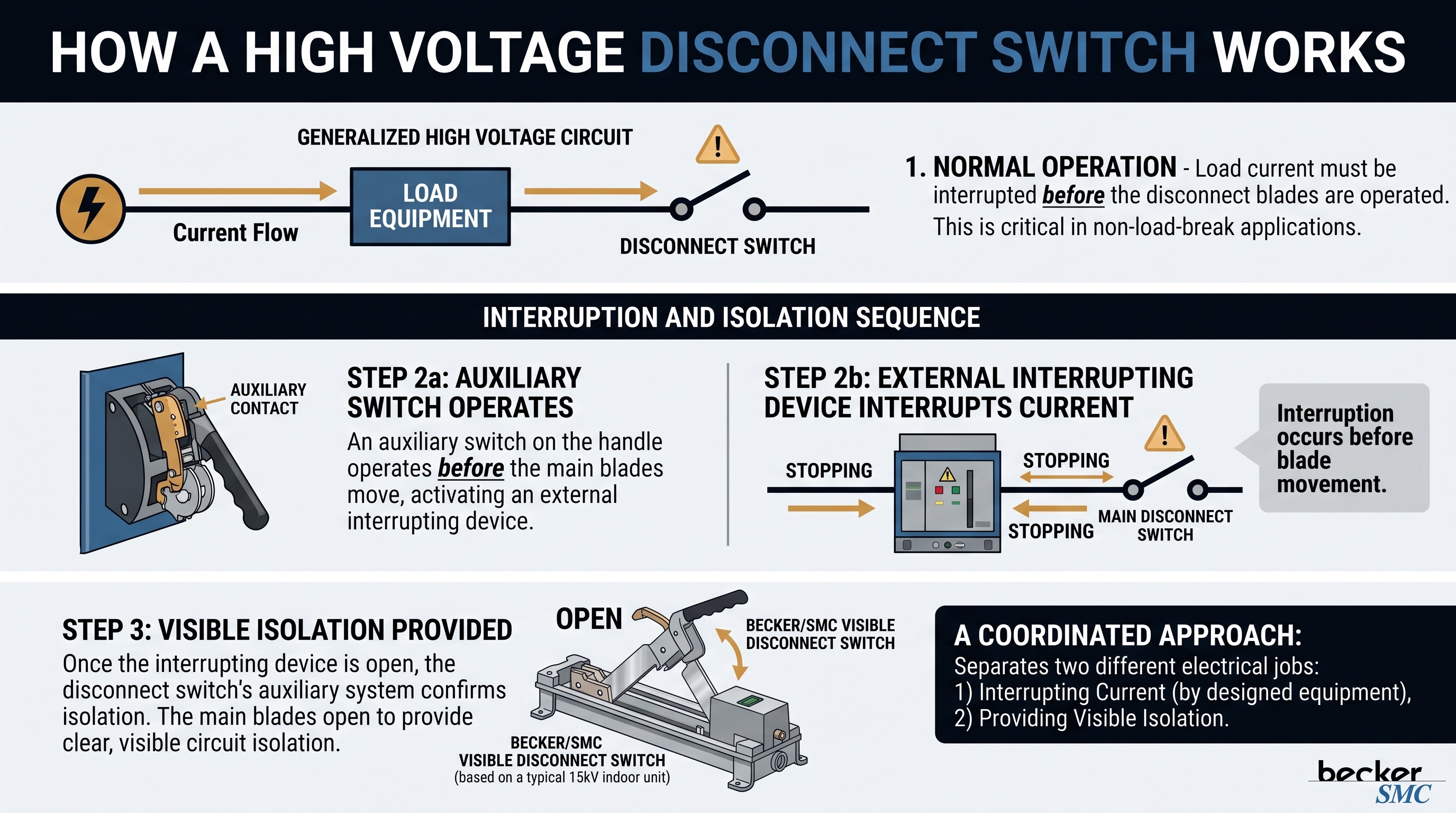
A high-voltage disconnect switch works by mechanically opening the conductive path between parts of an electrical circuit. Depending on its design and application, operation may be manual or incorporated into a larger control arrangement.
The basic sequence in a non-load-break application is important.
The load current must be interrupted by equipment designed for that purpose before the disconnect blades are operated. The disconnect can then provide physical circuit isolation.
Becker/SMC's visible disconnect switches illustrate this arrangement. They are designed for non-load-break applications through 15 kV. An auxiliary switch on the switch handle operates before the switch blades, allowing another device to perform the interruption before blade operation.
This coordinated approach separates two different electrical jobs: interrupting current and providing visible isolation.
GET IN TOUCH
In a hurry? Call us at 276-285-3841
High Voltage Disconnect Switch vs. Circuit Breaker
A disconnect switch and a circuit breaker may both appear in the same high-voltage distribution system, but their functions can be different.
A circuit breaker is designed to interrupt electrical current within its specified ratings, including abnormal current when properly applied with the required protection and controls. A non-load-break disconnect, by contrast, is primarily intended to isolate the circuit after current has been interrupted appropriately.
|
|
|
|
|
|
|
|
|
|
|
|
|
|
|
|
|
|
|
|
This difference matters when specifying equipment. A non-load-break disconnect should not be selected with the assumption that it can perform a load-breaking function unless the equipment is specifically designed and rated for that duty.
Why Is Visible Electrical Isolation Important?
Clear isolation provides qualified individuals with visible evidence of the disconnecting device's physical location, which is a prerequisite for following an established electrical safety program.
That does not, in and of itself, mean equipment should be assumed to be safe to touch.
Lockout/tagout procedures as required by OSHA electrical work practices, along with verification of that de-energization for circuit elements and equipment parts. Verification of de-energization (if needed) must be done by a qualified person with proper testing equipment.
This means, in practice, that the disconnect is one part of the safety and not a substitute to the process.
Depending on the installation and applicable requirements, the complete approach may include:
- Opening the appropriate interrupting device
- Operating the disconnect
- Applying required lockout/tagout controls
- Controlling stored electrical or other hazardous energy
- Testing to verify de-energization
- Following site-specific electrical safety procedures
Always follow the applicable regulations, equipment instructions, and facility procedures for the specific installation.
What Should You Look for in a High Voltage Disconnect Switch Supplier?
Choosing a high-voltage disconnect switch supplier in the USA requires more than comparing catalog listings. The switch needs to fit the electrical system around it.
Correct Voltage and Application Ratings
Start with the actual system requirements.
Voltage is an obvious consideration, but engineers also need to evaluate current, switching duty, available fault conditions, insulation requirements, system configuration, and the devices upstream and downstream from the disconnect.
A switch rated for one application should not be assumed suitable for another simply because the nominal voltage matches.
Load-Break vs. Non-Load-Break Requirements
This is one of the most important questions to resolve.
Does the switch need to interrupt load current, or will another properly rated device interrupt the current before the disconnect opens?
Becker/SMC's visible disconnect switches are specified as non-load-break switches through 15 kV. Their auxiliary-switch arrangement is intended to permit interruption by another device before the disconnect blades operate.
Knowing that requirement early helps prevent a basic mismatch between the device and its intended switching duty.
Coordination With Other Electrical Equipment
A disconnect rarely works as a stand-alone piece of equipment.
It might function with vacuum interrupters, circuit breakers, fuses, relays, transformers, switchgear, motor controls, and monitoring devices. This experience of integrating in the bigger electrical system is very valuable for suppliers to understand how these components could work together.
Protection and Control Options
Each of these installations does not share the same configuration.
Available equipment includes Becker/SMC switches and, in certain applications including Shunts Trip Devices, Auxiliary Switches, Fuse holder arrangements, and undervoltage.
The point is not to implement each and every available feature. It also requires choosing the features needed based on the protection and operating strategy of the system.
Support for Specialized Applications
Mining and heavy industrial electrical systems can place unusual demands on distribution equipment. Loads, operating environment, equipment arrangement, maintenance access, and existing infrastructure may all affect component selection.
A supplier that also understands transformers, switchgear, controls, connectors, monitoring equipment, and power distribution can evaluate a disconnect within that larger context.
Becker/SMC High Voltage Disconnect Switch Options
Becker/SMC supplies high-voltage disconnect equipment for electrical distribution applications where dependable switching and isolation are required.
Visible Disconnect Switches Through 15 kV
Our visible disconnect switches are available through 15 kV for non-load-break applications.
An auxiliary switch is provided on the switch handle and operates before the switch blades. This arrangement permits interruption by another appropriate device before blade operation.
Auxiliary Switches
Many Becker/SMC switch configurations offer auxiliary-switch options for the vacuum interrupter mechanism and operating shaft.
Auxiliary contacts can support control, sequencing, or indication functions depending on the system design.
Undervoltage and Shunt Trip Devices
Undervoltage and shunt-trip devices are available for selective tripping from different control functions.
These features can be important when the disconnect and associated switching equipment need to interact with a broader protection or control scheme.
Integral Fuseholders
Many Becker/SMC switches can be supplied with an attached fuseholder for up to 400 A.
These fuseholders accept fuses incorporating a spring-operated striker pin. When the fuse operates, the striker can activate mechanical linkage associated with an auxiliary switch. The resulting signal can then interact with a shunt-trip or undervoltage tripping attachment.
Integral fuseholder configurations are available through 15 kV applications.
Separate Fuseholders
Some new installations or retrofit projects may require a separate fuseholder.
Becker/SMC offers separate fuseholder arrangements with an auxiliary-switch option for local or remote annunciation, also available through 15 kV applications.
Where Are High Voltage Disconnect Switches Used?
High voltage disconnect switches can be used wherever an appropriately designed electrical distribution system requires circuit or equipment isolation.
Applications can include industrial distribution equipment, substations, transformers, switchgear assemblies, mining power systems, and other high-voltage infrastructure.
The exact switch should always be selected according to the actual electrical system rather than the industry name alone.
For mining operations, for example, high-voltage power can feed transformers, power centers, switchgear, conveyors, pumps, ventilation equipment, crushers, and other large loads. Isolation and protection must work as coordinated parts of that distribution network.
Why Work With Becker/SMC?
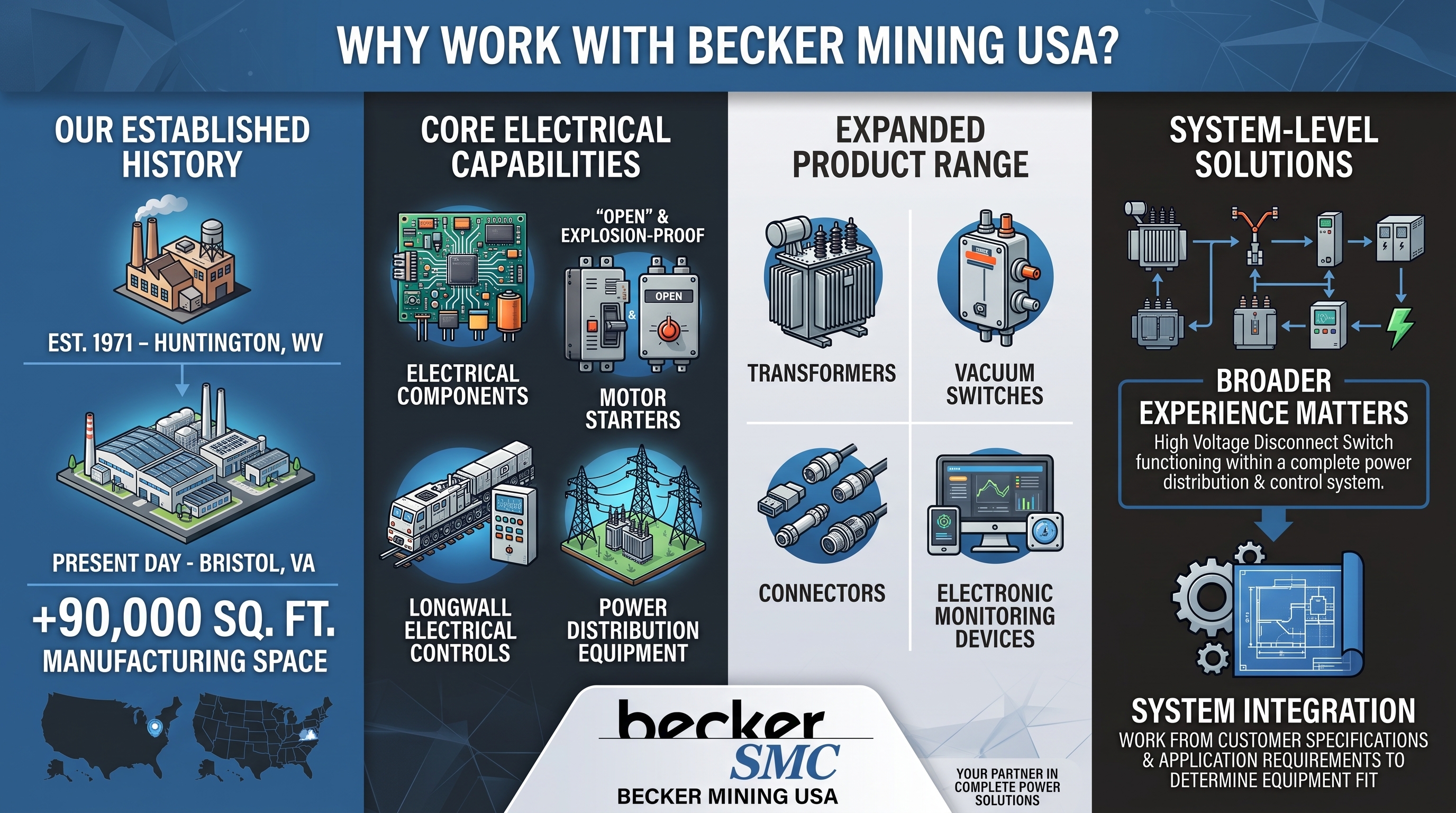
Becker/SMC has been operating since 1971, when the company was established in Huntington, West Virginia. Today, our operation is located in Bristol, Virginia, with more than 90,000 square feet of manufacturing space.
Our work extends beyond individual disconnect switches. We design and manufacture electrical components, open-type and explosion-proof motor starters, longwall electrical controls, and power distribution equipment. Our product capabilities have also expanded to include transformers, vacuum switches, connectors, and electronic monitoring devices.
That broader experience matters when a high voltage disconnect switch must function as part of a complete power distribution and control system.
Rather than looking only at one component, we can work from customer specifications and application requirements to determine how equipment needs to fit together.
GET IN TOUCH
In a hurry? Call us at 276-285-3841
Questions to Ask Before Ordering a High Voltage Disconnect Switch
Before selecting a switch, define the application as clearly as possible.
Useful questions include:
- What is the system's nominal operating voltage?
- What continuous current rating is required?
- Is the application load-break or non-load-break?
- What device will interrupt current before a non-load-break disconnect operates?
- Is visible isolation required?
- Does the system need an integral or separate fuseholder?
- Are auxiliary contacts needed for sequencing or indication?
- Are undervoltage or shunt-trip functions required?
- What existing switchgear, transformers, relays, or protection devices must the switch coordinate with?
- Is this a new installation or a retrofit into existing equipment?
Answering these questions before requesting a quote makes it easier to identify a configuration suited to the actual electrical system.
Talk to a High Voltage Disconnect Switch Supplier in the USA
The right high voltage disconnect switch must match the electrical system, switching duty, protection strategy, and operating requirements of the application.
At Becker/SMC, we manufacture high-voltage disconnects and related electrical distribution components for demanding applications. Our visible disconnect switches are available through 15 kV for non-load-break applications, with additional configurations and control features available depending on system requirements.
If you are replacing an existing disconnect, designing new electrical distribution equipment, or evaluating a specialized application, contact Becker/SMC to discuss your voltage, current, switching, protection, and equipment requirements.
Frequently Asked Questions
Q: What is a high voltage disconnect switch?
A: A high voltage disconnect switch is a mechanical switching device used to isolate a circuit or piece of electrical equipment from its source of power. Depending on the design, it can provide visible physical separation within the electrical path.
Q: Can a high voltage disconnect switch interrupt load current?
A: Not necessarily. Disconnect switches must be used according to their specific design and ratings. Becker/SMC visible disconnect switches are designed for non-load-break applications through 15 kV, so another appropriate device interrupts current before the disconnect blades operate.
Q: What is the difference between a disconnect switch and a circuit breaker?
A: A disconnect switch primarily provides electrical isolation, while a circuit breaker is designed to interrupt current within its specified ratings and protection scheme. In many systems, the devices work together rather than replacing one another.
Q: What voltage are Becker/SMC visible disconnect switches rated for?
A: Becker/SMC states that its visible, non-load-break disconnect switches are available rated through 15 kV.
Q: Does Becker/SMC offer fused high voltage disconnect options?
A: Many Becker/SMC switches can be provided with an attached fuseholder for up to 400 A, with availability through 15 kV applications. Separate fuseholder arrangements are also available for applicable new or retrofit installations.
Q: How do I select the right high voltage disconnect switch?
A: Start with system voltage, continuous current, required switching duty, protection scheme, fuse requirements, control functions, existing equipment, and installation conditions. For a non-load-break disconnect, it is especially important to determine what properly rated device will interrupt current before the disconnect operates.
Products We Offer:
- Explosion Proof Equipment
- Transformers
- Arc Guard
- Longwall Electrical Systems
- Capacitor Trip Devices
- Electrical Equipments like capacitor banks, switch houses, junctions, and splice boxes.
Power up your productivity with Becker Mining's ground fault relays - the reliable and efficient solution for all your power distribution needs. Call us today!