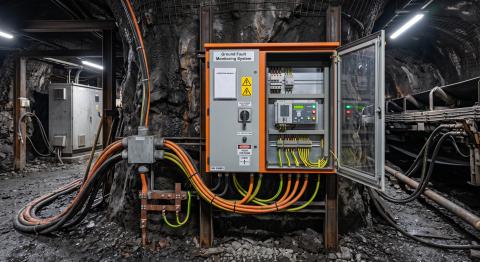
Electrical faults are especially serious in mining because power systems often serve large motors, mobile equipment, trailing cables, pumps, conveyors, ventilation equipment, and other machinery operating in demanding conditions.
Ground fault systems detect electrical faults by looking for current or voltage that is behaving differently from what a healthy circuit should produce. In a three-phase mining circuit, that often means monitoring for an imbalance in phase current, current returning through an unintended ground path, a change in neutral-to-ground conditions, or deterioration in the insulation separating energized conductors from ground.
Once a fault reaches the system's operating threshold, the protective relay can signal a circuit breaker or other interrupting device to de-energize the affected circuit.
At Becker Mining USA, we work with electrical power and control equipment designed specifically for mining environments, where fault protection has to work as part of a much larger power distribution and safety system. Becker Mining Systems' electrical portfolio includes energy distribution, automation, communication, transformers, switchgear, and other mining infrastructure.
Key Takeaways
- Ground fault systems identify current leaving its intended electrical path, often by measuring the combined current of all phase conductors through a current transformer.
- In a healthy three-phase circuit, phase currents balance. A ground fault creates residual or zero-sequence current that a protective relay can detect.
- Mining systems may use resistance grounding to control the amount of current that can flow during a phase-to-ground fault while still making the fault detectable.
- Ground fault detection and ground fault locating are different processes: protection identifies a dangerous electrical condition, while locating determines where the cable or insulation failure physically exists.
- Some mining installations also use ground-check and look-ahead circuits to detect unsafe grounding conditions before or while equipment is energized.
- The correct protection arrangement depends on system voltage, grounding method, equipment design, mine type, and applicable MSHA requirements.
What Is a Ground Fault in a Mining Electrical System?
A ground fault occurs when an energized conductor develops an unintended electrical connection to ground or to grounded equipment.
That path may develop because of damaged cable insulation, moisture intrusion, crushed or abraded conductors, equipment failure, contamination, or another insulation breakdown. Instead of all current remaining within its intended circuit, some current flows through the grounding system, equipment frame, earth, or another unintended conductive path.
Mining makes this problem more complicated than it may be in an ordinary building.
Cables may be moved repeatedly. Mobile machinery creates vibration and mechanical stress. Electrical equipment may operate in wet, dirty, abrasive, or confined environments. Underground power systems can also extend considerable distances between the power source and the equipment being supplied.
Because of these conditions, a mining ground fault system has to do more than recognize a large short circuit. It often needs to detect relatively small abnormal currents before they develop into a more serious electrical event.
How Do Ground Fault Systems Detect a Fault?
Most mining ground fault systems work by establishing what normal electrical conditions should look like and then monitoring for a measurable departure from those conditions.
One of the most common approaches uses a current transformer around the phase conductors.
In a normal three-phase circuit, the instantaneous vector sum of the phase currents is essentially zero. Current flowing toward the load through one or more phases is balanced by current returning through the other phases.
When current leaks from one phase to ground, that balance changes.
The current transformer senses the remaining imbalance. A ground fault relay measures that signal and compares it with a predetermined pickup setting. If the measured ground fault exceeds that setting for the required amount of time, the relay tells the circuit interrupting device to open.
MSHA requirements and approved mining arrangements demonstrate this principle in practice. For certain high-voltage continuous mining machine applications, MSHA specifies a single-window current transformer that encircles all three phase conductors while excluding the equipment grounding conductor.
The Basic Detection Sequence
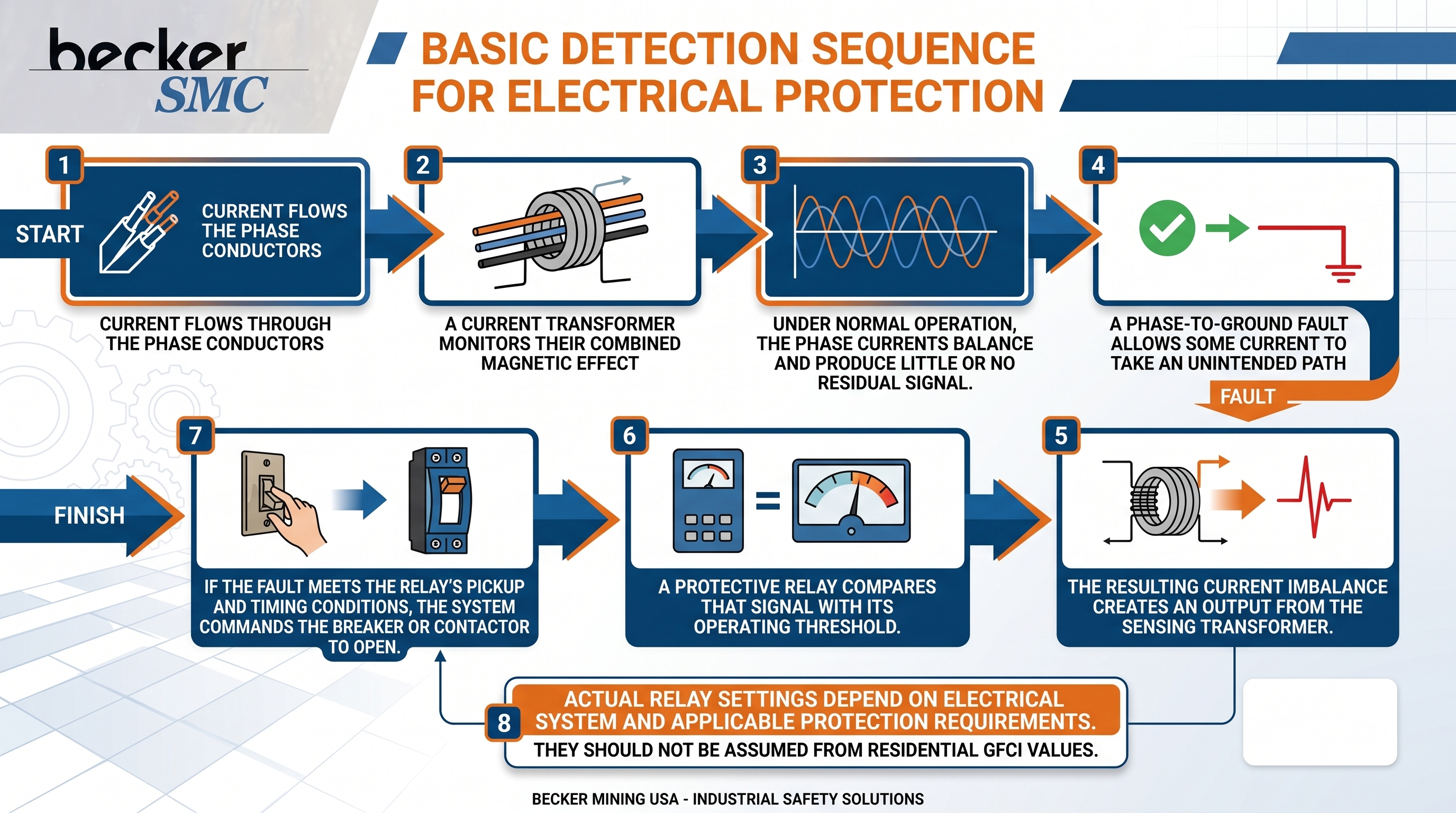
A typical protection sequence looks like this:
- Current flows through the phase conductors.
- A current transformer monitors their combined magnetic effect.
- Under normal operation, the phase currents balance and produce little or no residual signal.
- A phase-to-ground fault allows some current to take an unintended path.
- The resulting current imbalance creates an output from the sensing transformer.
- A protective relay compares that signal with its operating threshold.
- If the fault meets the relay's pickup and timing conditions, the system commands the breaker or contactor to open.
The actual relay settings depend on the electrical system and applicable protection requirements. They should not be assumed from residential GFCI values.
GET IN TOUCH
In a hurry? Call us at 276-285-3841
Why Mining Ground Fault Protection Is Different From a Household GFCI
The principle is related, but the application is very different.
A household Ground Fault Circuit Interrupter commonly compares current leaving and returning through a circuit and trips when a very small imbalance is detected. That familiar example helps explain differential sensing, but mining power systems often involve three-phase circuits, higher voltages, resistance grounding, large machinery, protective relays, and coordinated circuit breakers.
Mining protection also has to account for the way the distribution system itself is grounded.
For underground coal mine power systems, for example, federal requirements include grounding arrangements designed to control fault current and continuously monitor portions of the grounding circuit. The Federal Mine Safety and Health Act describes resistance grounding for underground high-voltage systems and calls for fail-safe ground-check monitoring that opens the breaker if the grounding or pilot-check circuit is interrupted.
That makes a mining ground fault system part of a coordinated protection scheme rather than simply a stand-alone leakage detector.
How Core-Balance Current Transformers Detect Ground Faults
A core-balance current transformer, sometimes called a zero-sequence current transformer, is one of the most useful devices for detecting ground faults in a three-phase system.
All three phase conductors pass through the same transformer window.
Under normal conditions:
IA + IB + IC ≈ 0
Because the currents are balanced, their magnetic effects largely cancel each other.
During a ground fault:
IA + IB + IC ≠ 0
The missing current has gone somewhere outside the intended phase circuit. That residual current creates magnetic flux in the transformer core, which produces a secondary signal for the ground fault relay.
This arrangement is useful because the relay does not need to determine which individual phase has failed before recognizing that current is escaping from the normal circuit.
Why the Grounding Conductor Stays Outside the CT
The grounding conductor should not pass through the same sensing window in arrangements designed to detect zero-sequence current.
If fault current leaves a phase conductor and then returns through a grounding conductor that also passes through the transformer, the two currents could partially cancel from the sensor's perspective. Keeping the grounding conductor outside the window allows the phase-current imbalance to remain visible to the relay.
MSHA documentation for certain mining applications specifically calls for single-window current transformers around all three phase conductors while excluding equipment grounding conductors.
What Does the Neutral Grounding Resistor Do?
A neutral grounding resistor, or NGR, limits the current that can flow during a phase-to-ground fault.
That is an important distinction: the resistor usually does not detect the fault by itself. It controls the fault current so the protection system can respond in a predictable way.
In a resistance-grounded mining power system, the transformer neutral is connected to ground through a resistor rather than being connected directly to ground.
When a phase-to-ground fault occurs, current flows through a path that includes the grounding system and neutral grounding resistor. The resistor limits how large that current can become.
For underground low- and medium-voltage three-phase coal mine circuits covered by federal requirements, the Mine Act specifies resistance grounding and limits ground fault current through the grounding resistor. High-voltage underground systems also use grounding resistors under applicable requirements.
Controlling fault current helps reduce electrical stress while still providing enough measurable current for the protective relay to recognize the fault.
What Is a Ground Fault Relay?
A ground fault relay is the decision-making part of the protection system.
The sensor—often a current transformer—produces an electrical signal representing the amount of residual or ground fault current. The relay evaluates that signal.
Depending on its design and settings, the relay may consider:
- Fault current magnitude
- Pickup threshold
- Time delay
- Circuit voltage
- Status of other protection devices
- Grounding resistor conditions
- Whether the circuit is energized or preparing to energize
When the operating criteria are reached, the relay initiates a trip signal.
That separation between sensing and decision-making matters. The current transformer detects the abnormal current, while the relay determines whether that condition requires action.
Why Ground Fault Protection Uses Time and Current Settings
Not every abnormal electrical signal should necessarily trip every breaker at the same instant.
Mining distribution systems can contain several levels of protection. A downstream fault should ideally be cleared by the protective device closest to the affected circuit instead of shutting down an unnecessarily large portion of the mine.
This is known as protective coordination.
A ground fault relay may therefore have both a current pickup setting and a time-delay setting. These values allow engineers to coordinate downstream and upstream protection while still meeting required safety limits.
Certain MSHA-approved high-voltage continuous-miner arrangements, for example, specify ground fault current limits, relay pickup levels, maximum operating delays, and backup ground fault protection. The exact values are application-specific rather than universal settings for every mining system.
What Is a Look-Ahead Ground Fault Circuit?
A look-ahead circuit checks for a ground fault before the system allows a circuit breaker or contactor to close.
This matters because conventional ground fault protection normally needs an energized circuit before current can flow and be measured. If a trailing cable already has damaged insulation and a phase conductor is effectively connected to ground, energizing it just to discover the fault creates an unnecessary hazard.
A look-ahead circuit uses an impedance-measuring or monitoring function to determine whether an unacceptable ground condition already exists.
If it detects one, the protective system prevents the circuit from being energized.
MSHA has required this type of protection in certain high-voltage continuous mining machine arrangements specifically to prevent a circuit-interrupting device from closing onto an existing ground fault.
That gives the system two layers of protection:
Before energization: Is there already a ground fault?
After energization: Has ground fault current developed during operation?
What Causes Ground Faults in Mining Equipment?
Ground faults generally begin when insulation or separation between an energized conductor and ground is compromised.
In a mining environment, possible causes include:
- Trailing cable damage from mobile equipment
- Crushed, cut, or abraded cable insulation
- Moisture entering electrical equipment
- Contamination inside enclosures
- Failed motor or transformer insulation
- Loose or damaged electrical terminations
- Excessive heat
- Repeated vibration
- Aging insulation
- Mechanical damage during equipment movement
Trailing cables deserve particular attention because they operate between power centers and mobile mining machinery and may be exposed to repeated movement and mechanical stress.
Federal mining requirements specifically address protecting trailing cables from damage and strain at electrical connections.
Ground Fault Detection vs. Ground Fault Locating
Ground fault detection tells you that a fault exists.
Ground fault locating tells you where the fault is.
Those jobs may require completely different equipment.
The competitor resource from CNI Locates focuses heavily on fault locating in buried cables. Its process uses a transmitter and A-frame receiver to apply a fault-finding signal and trace the point where that signal enters the earth.
That is useful after a faulted conductor has been identified, but it is not the same process as the protective relaying used to detect electrical faults on energized mining power circuits.
A mining protection sequence might therefore look like this:
Detect → Trip → Isolate → Test → Locate → Repair → Verify → Re-energize
The protective relay's first job is not to identify the exact centimeter of damaged cable. Its job is to recognize an unsafe electrical condition and initiate the required protective response.
Why Testing Ground Fault Protection Matters
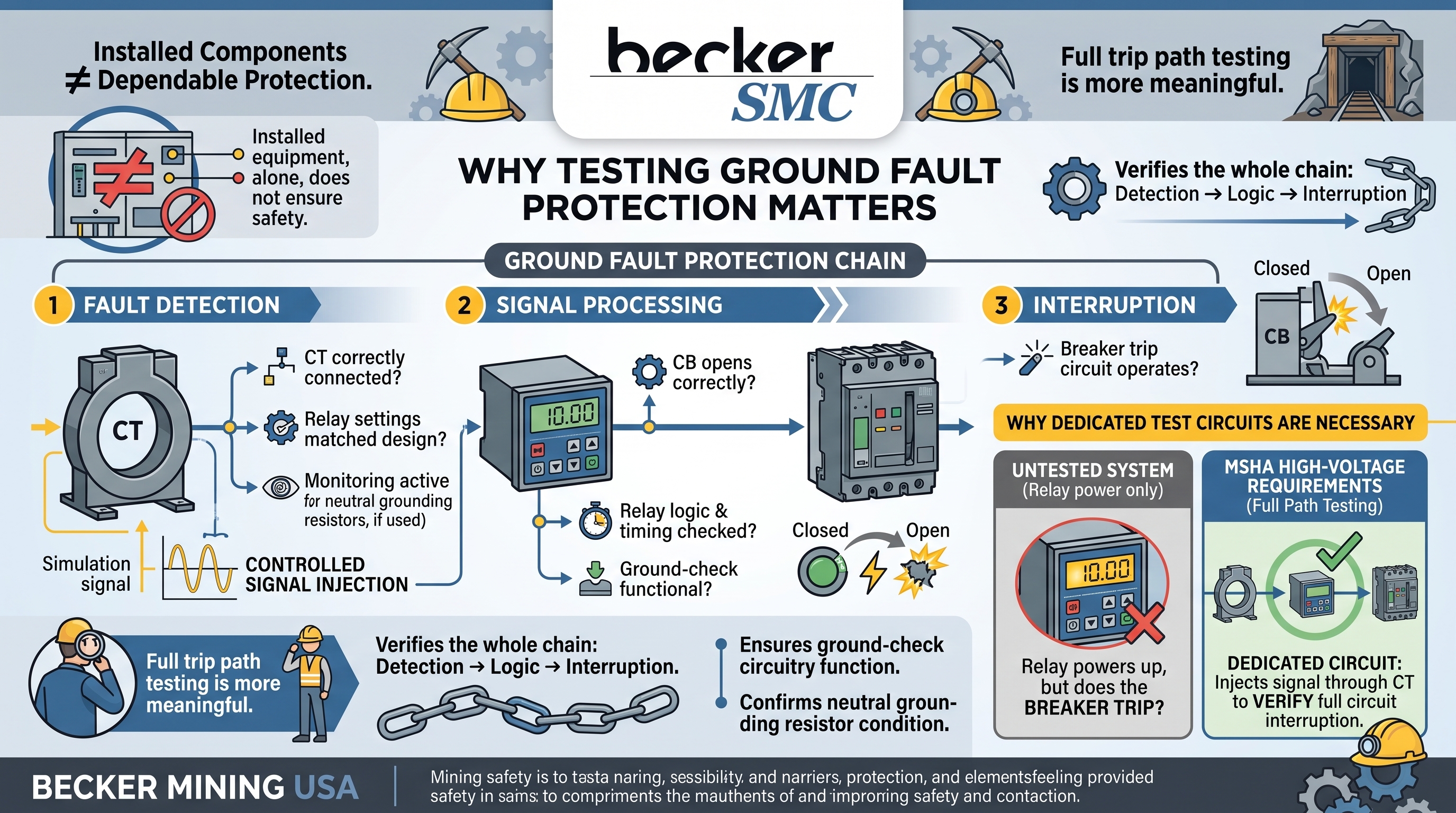
A protection system cannot provide dependable protection simply because the components are installed.
The current transformer has to be connected correctly. Relay settings must match the design. Breaker trip circuits have to operate. Ground-check circuitry has to remain functional. Where neutral grounding resistors are used, the resistor and associated monitoring must also be in proper condition.
That is why mining protection systems often include dedicated test circuits.
In certain MSHA high-voltage applications, requirements call for test circuitry that injects a controlled signal through the current transformer and verifies that the corresponding circuit-interrupting device opens.
Testing the full trip path is more meaningful than confirming that a relay display powers up.
The real question is whether the protection chain works from detection all the way through circuit interruption.
GET IN TOUCH
In a hurry? Call us at 276-285-3841
How Ground Fault Systems Fit Into Mining Power Distribution
Ground fault protection is only one layer of an electrical protection system.
Mining circuits may also require protection or monitoring for conditions such as:
- Short circuits
- Overcurrent
- Undervoltage
- Grounding continuity
- Open neutral grounding resistor conditions
- Thermal stress
- Existing faults before energization
MSHA requirements for underground coal mine power systems show how several of these functions work together rather than independently.
The goal is selective protection. A well-designed system detects the electrical condition, isolates the affected portion of the network when required, and prevents one failure from creating a larger hazard.
At Becker Mining USA, our electrical product offering includes transformers, distribution equipment, monitoring devices, explosion-proof equipment, and complete longwall electrical systems designed around the requirements of mining power distribution.
What Should a Mine Consider When Selecting Ground Fault Protection?
There is no single ground fault relay setting or detection method that fits every mine electrical system.
The protection scheme should be evaluated around the actual system, including:
System Voltage
Higher-voltage systems can involve different grounding and protection requirements than lower-voltage circuits.
Grounding Method
A solidly grounded, resistance-grounded, and ungrounded system behave differently during a phase-to-ground fault.
Available Fault Current
The grounding arrangement determines how much current is expected to flow through the fault path.
Equipment Being Protected
A stationary feeder, power center, motor circuit, longwall system, and mobile machine trailing cable may require different protection strategies.
Cable Length and Configuration
Long cables add impedance and capacitance and can affect how electrical conditions appear to protective equipment.
Coordination With Other Relays
Ground fault protection needs to operate with upstream and downstream protective devices rather than treating every fault as a reason to disconnect the entire distribution system.
Applicable Mining Regulations
Requirements vary with mine type, system voltage, equipment, and jurisdiction. For U.S. mine operators, MSHA requirements and equipment approvals should be evaluated for the specific application rather than relying on a generic industrial protection setting.
Build Ground Fault Protection Around the Entire Mining Electrical System
Effective ground fault systems do more than detect electricity touching ground. They combine sensing, protective relays, grounding design, circuit interruption, monitoring, and testing into a coordinated safety system.
A core-balance current transformer can recognize current that has escaped the normal three-phase path. A ground fault relay decides whether the condition requires a trip. A neutral grounding resistor controls the available fault current. Ground-check circuits monitor grounding continuity, while look-ahead protection can prevent equipment from being energized when a fault already exists.
Those functions are most effective when they are designed as part of the mine's complete electrical distribution system.
At Becker Mining USA, we provide electrical equipment and integrated mining power solutions for demanding underground and surface applications. If you are evaluating ground fault protection, power distribution equipment, transformers, switchgear, or a complete mining electrical system, contact our team to discuss the requirements of your operation.
Frequently Asked Questions
Q: What does a ground fault system detect?
A: A ground fault system detects electrical current or another measurable electrical condition showing that electricity has left its intended circuit and established a path toward ground. In three-phase systems, this is commonly detected as residual current through a core-balance current transformer.
Q: Does a ground fault relay detect which phase is faulted?
A: Not necessarily. A zero-sequence or core-balance current transformer can detect that an imbalance exists without independently identifying the affected phase. Additional monitoring or diagnostic testing may be needed to determine which conductor or component has failed.
Q: What is zero-sequence current?
A: Zero-sequence current is the residual current obtained from the vector sum of the three phase currents. In a balanced healthy system, that sum is near zero. During a phase-to-ground fault, the current no longer balances, creating a measurable zero-sequence component.
Q: Why do mines use resistance grounding?
A: Resistance grounding limits phase-to-ground fault current to a controlled value. This can reduce electrical stress while keeping the fault measurable by protective relays. The required grounding arrangement depends on the circuit and applicable mining regulations.
Q: What is the difference between a ground fault relay and a ground-check relay?
A: A ground fault relay detects unintended current flowing to ground. A ground-check system monitors the continuity of the grounding path itself. Both can be important because a grounding conductor may fail even when no phase-to-ground fault is currently present.
Products We Offer:
- Explosion Proof Equipment
- Transformers
- Arc Guard
- Longwall Electrical Systems
- Capacitor Trip Devices
- Electrical Equipments like capacitor banks, switch houses, junctions, and splice boxes.
Power up your productivity with Becker Mining's ground fault relays - the reliable and efficient solution for all your power distribution needs. Call us today!