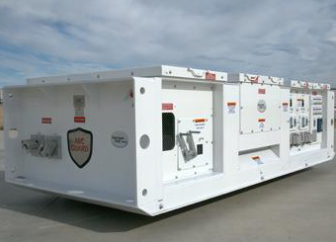
A mine may specify arc resistant switchgear when workers could be exposed to an internal arcing fault during equipment operation, inspection, or maintenance—and the equipment’s tested design can help manage the effects of that fault. The decision depends on the electrical system, the work performed around the gear, and the exact protection the equipment is tested to provide.
In a mine power center, switchgear works alongside transformers, protective devices, cables, and downstream equipment. Specifying arc-resistant construction can add a layer of protection, but it does not prevent every fault or replace an arc-flash study, safe work procedures, or properly selected protective equipment.
Key Takeaways
- Consider arc-resistant equipment when workers may be near energized gear during normal operation or routine tasks.
- Base the specification on available fault current, clearing time, equipment configuration, and worker access.
- Confirm the test standard, tested configuration, and protection classification for the specific equipment being purchased.
- Arc-resistant construction and arc-flash calculations address different aspects of electrical safety.
- The equipment still needs to be installed, maintained, and operated within its tested limits.
When Should A Mine Specify Arc-Resistant Switchgear?
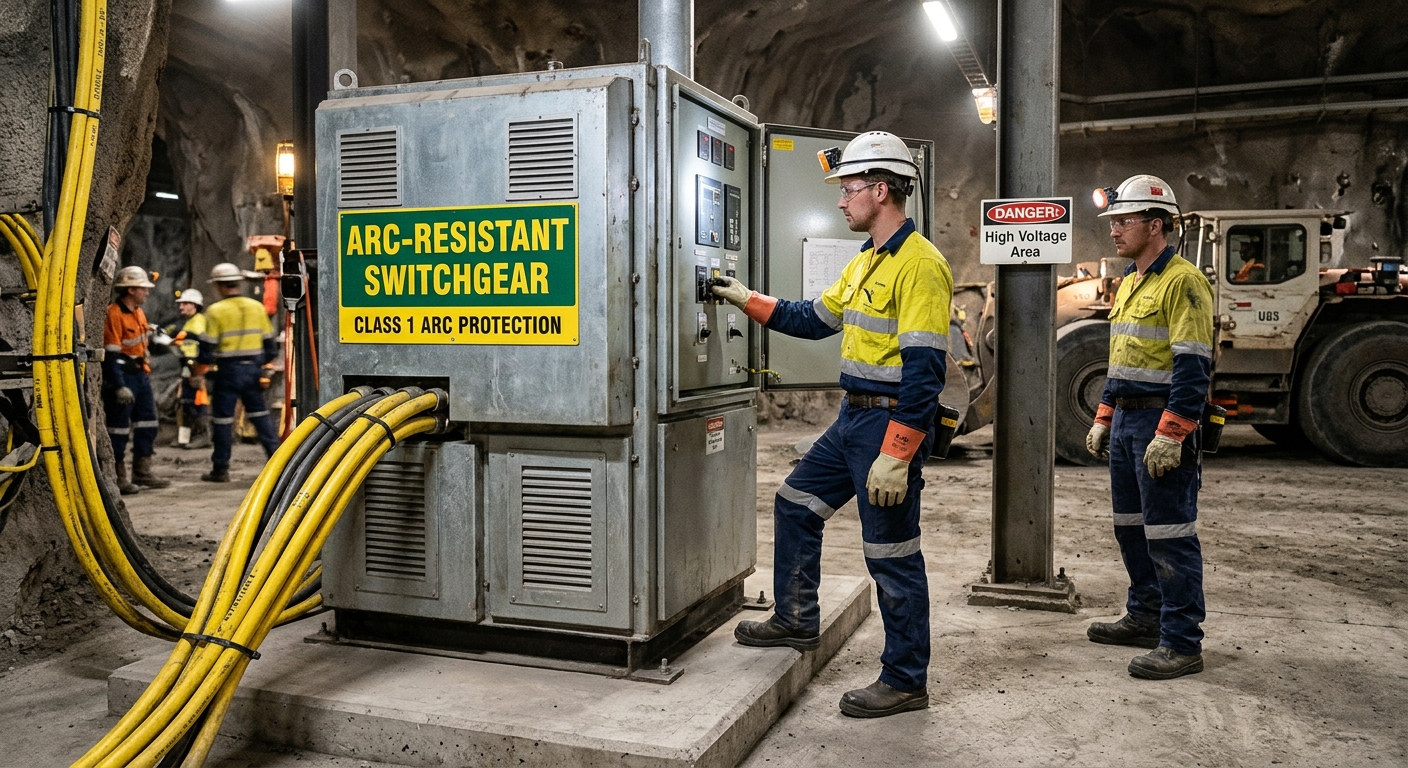
A mine should evaluate arc-resistant switchgear when an internal fault could expose people near the equipment to hazardous pressure, hot gases, or debris. This can matter where equipment is routinely operated or inspected in locations with limited clearance, such as near a power center or within a confined work area.
The specification should reflect actual operating conditions. Ask:
- Will workers stand near the equipment during switching or inspection?
- Is equipment located where people regularly travel or perform work?
- How much fault current is available, and how quickly can protective devices clear a fault?
- Is the equipment fixed, mobile, or part of a power center that may be relocated?
- What does the mine’s electrical hazard analysis say about exposure?
These questions help determine whether arc-resistant construction addresses a meaningful risk in the planned installation. The answer may differ between a new power center, a switchgear replacement, and a retrofit of existing equipment.
What Does An Arc-Resistant Rating Tell Mine Operators?
Arc-resistant testing evaluates how a particular equipment design performs during an internal arcing fault under specified test conditions. covers testing and evaluating switchgear rated up to 52 kV for internal arcing faults; it also discusses equipment application, installation, and service conditions. A rating should therefore be reviewed alongside the equipment’s test documentation and installation requirements.
A rating is not a general promise that workers are protected in every situation. The tested configuration matters. Enclosure construction, covers, ventilation paths, equipment layout, and installation can affect whether the equipment in the mine matches the conditions represented by the test.
When reviewing a proposal, ask the supplier to identify the standard edition, test results, tested arrangement, and limits of the claimed protection. For equipment tested under an older edition, confirm with the project engineer whether that documentation meets the project’s current requirements.
GET IN TOUCH
In a hurry? Call us at 276-285-3841
How Is Arc-Resistant Equipment Different From An Arc-Flash Study?
Arc-resistant equipment and an arc-flash study answer different questions.
An arc-flash study estimates potential exposure—such as incident energy and arc-flash boundaries—under defined system conditions. Arc-resistant testing examines how equipment performs during an internal arcing fault. IEEE C37.20.7 addresses equipment testing, while IEEE 1584 provides calculation methods for arc-flash hazards within its scope. Neither replaces the other.
For mine operators, the practical point is to consider both the likely worker exposure and the equipment’s ability to manage an internal fault. Protective relays and breakers still need to be selected and coordinated for the system. Workers also need appropriate electrical safety procedures and protective equipment. MSHA’s arc-flash safety alert emphasizes de-energizing, locking out and tagging circuits, identifying hazardous energy sources, and using properly rated tools and protective equipment.
What Should Be Included In A Mine Power-Center Specification?
A useful specification gives suppliers enough information to match the equipment to the mine’s system and work environment.
Include:
- Electrical system details: operating voltage, frequency, available fault current, grounding method, and connected loads.
- Protection requirements: protective-device types, settings, expected clearing times, and coordination requirements.
- Equipment arrangement: compartments, access points, clearances, mounting or skid details, and ventilation.
- Work conditions: where workers may stand during operation or inspection, and whether equipment will be moved or serviced underground.
- Testing documentation: applicable standard and edition, tested configuration, and the specific protection classification required.
- Installation and maintenance requirements: clearances, vent paths, inspection needs, and any limits that must be maintained for the protection to apply.
A specification that simply says “arc resistant” may leave important details unresolved. We recommend reviewing the complete power-center design and the equipment documentation together, especially when replacing older gear or integrating new equipment into an existing mine system.
Where Becker Mining USA’s Arc Guard Power Center May Fit
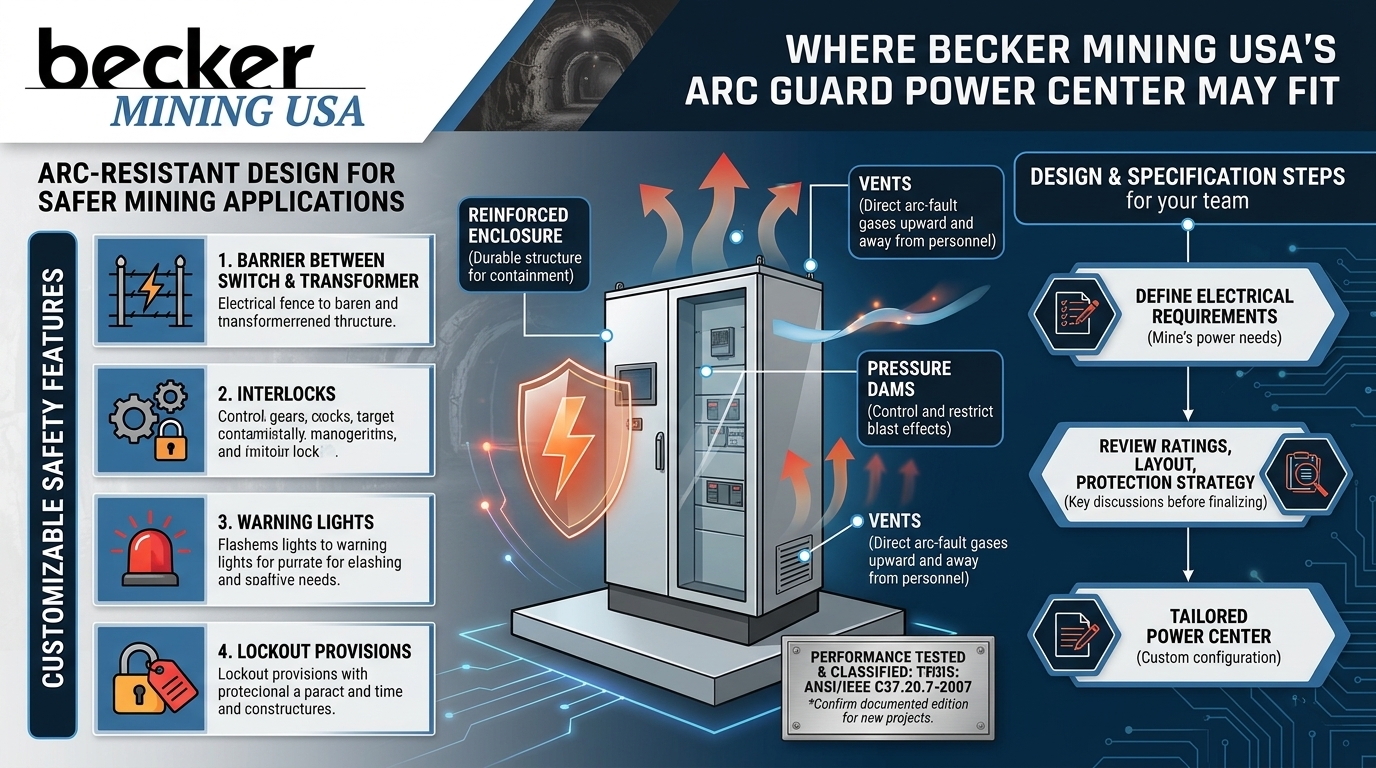
At Becker Mining USA, we design power-distribution equipment for mining applications. Our Arc Guard Power Center uses a reinforced enclosure, pressure dams, and vents intended to direct arc-fault gases upward and away from personnel. Becker’s product documentation states that the equipment was performance tested and classified as arc resistant under ANSI/IEEE C37.20.7-2007. For a new project, confirm that the documented test edition and configuration meet the project’s current requirements.
Our mine power centers can be designed around a mine’s electrical requirements and may include features such as a barrier between the primary switch and transformer compartment, interlocks, warning lights, and lockout provisions. The right design depends on the system and installation, so the project team should review the required ratings, layout, and protection strategy before finalizing the specification.
GET IN TOUCH
In a hurry? Call us at 276-285-3841
Talk With Becker Mining USA About Your Power-Center Requirements
Choosing arc-resistant equipment starts with understanding the mine’s electrical system and how people work around it. Becker Mining USA can help review your power-center requirements and determine whether our Arc Guard Power Center fits the project. Contact our team to discuss the application and supporting documentation.
Frequently Asked Questions
Q: Does arc-resistant switchgear prevent an arc flash?
A: No. Arc-resistant construction is designed to manage the effects of an internal arcing fault within the limits of the tested equipment configuration. It does not prevent every fault or eliminate electrical hazards.
Q: Does a mine need arc-resistant equipment if it already has an arc-flash study?
A: An arc-flash study and arc-resistant equipment testing serve different purposes. A mine may use both as part of its electrical safety strategy, depending on the study results, equipment, and work conditions.
Q: What should we verify before ordering arc-resistant equipment?
A: Confirm the equipment’s voltage and fault-current ratings, tested arrangement, applicable standard and edition, installation requirements, and how the protection applies to the intended mine power-center configuration.
Q: Can arc-resistant equipment replace lockout/tagout or PPE?
A: No. Equipment features do not replace safe work procedures, energy isolation, electrical hazard assessments, or protective equipment selected for the task.
Products We Offer:
- Explosion Proof Equipment
- Transformers
- Arc Guard
- Longwall Electrical Systems
- Capacitor Trip Devices
- Electrical Equipments like capacitor banks, switch houses, junctions, and splice boxes.
Power up your productivity with Becker Mining's ground fault relays - the reliable and efficient solution for all your power distribution needs. Call us today!