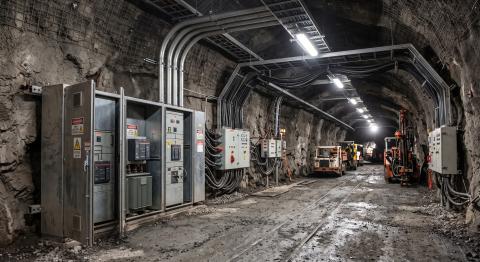
Modern mines depend on electrical power for far more than keeping the lights on. Conveyors, pumps, ventilation equipment, crushers, longwall systems, processing equipment, and other critical machinery all depend on electrical systems that can deliver the right voltage while controlling equipment safely and responding quickly when a fault occurs.
A mine electrical system is the network of equipment used to receive, transform, distribute, control, monitor, and protect electrical power throughout a mining operation. Power control starts with the incoming electrical supply and continues through switchgear, transformers or power centers, motor controls, protective devices, cables, connectors, and the equipment using the power.
At Becker/SMC, we design and manufacture electrical components, motor starters, longwall electrical controls, power distribution equipment, transformers, switches, connectors, and monitoring devices for mining and other industries. That experience gives us a practical view of mine power: reliable operation depends on how the entire electrical system works together, not on any one component.
Key Takeaways
- Mine electrical systems move power from the incoming supply to usable voltages for equipment while controlling where, when, and how that power is delivered.
- Switchgear, transformers, power centers, motor controls, protection devices, grounding systems, and monitoring equipment perform different but connected jobs.
- Power circuits carry the electrical energy required by machinery, while lower-power control circuits tell equipment when and how to operate.
- Electrical protection must detect abnormal conditions and isolate affected portions of the system before a fault creates a larger equipment or personnel hazard.
- A reliable system must be designed around actual mine loads, distances, equipment locations, operating conditions, and the consequences of losing particular circuits.
- Monitoring becomes more valuable when operators can use the information to identify problems early rather than simply react after equipment shuts down.
How Do Mine Electrical Systems Work?
Mine electrical systems work by receiving electrical power, transforming it to appropriate voltage levels, distributing it to different areas, and controlling individual loads while protecting the network from abnormal conditions.
Think of the system as a chain rather than a collection of separate electrical boxes.
Incoming power may first pass through high-voltage switchgear. Transformers or power centers then provide the voltage required farther downstream. Distribution equipment routes that power toward different sections of the mine. Motor starters, contactors, drives, relays, and control systems determine how individual machines operate.
Protection and monitoring run alongside that entire chain.
If a short circuit, ground fault, overload, loss of phase, or another unsafe electrical condition occurs, the system needs a way to detect the problem and isolate the affected circuit. That prevents one electrical problem from unnecessarily becoming a mine-wide problem.
This system-level view is becoming more important as mines depend on more electrically powered equipment. Hitachi Energy, for example, describes reliable and stable electrical power as an operating foundation for increased electrification, automation, monitoring, and data-driven mining operations.
The Main Components of a Mine Electrical System
The exact design varies from one operation to another, but most mine electrical distribution systems rely on several core functions.
High-Voltage Switchgear Controls Incoming Power
High-voltage switchgear provides switching, isolation, and protection for higher-voltage portions of the electrical system.
Circuit breakers, disconnects, protective relays, and related components allow sections of the system to be energized or isolated as operating conditions require.
This matters because mine power systems often serve large loads spread over considerable distances. A fault needs to be isolated as selectively as the system permits. Otherwise, an electrical problem affecting one circuit may interrupt equipment that was not directly involved.
For certain underground coal mine high-voltage circuits, federal mine-safety requirements call for circuit breakers with protection against conditions including undervoltage, grounded phase, short circuit, and overcurrent.
Switchgear selection therefore involves more than voltage and amperage. Engineers also need to consider available fault current, interrupting capacity, coordination with downstream protection, operating environment, access, equipment configuration, and maintenance requirements.
Transformers and Power Centers Step Voltage Down
Mine power centers transform incoming voltage into the utilization voltage required by downstream mining equipment while combining distribution and protection functions in a practical package.
Higher voltage is useful for transmitting substantial amounts of power over distance because it can reduce the current required for a given amount of power. The voltage still has to be transformed before it can serve equipment designed for lower operating voltages.
Becker/SMC mine power centers, for example, are available for applications with input voltages from 5 kV to 25 kV and outputs from 480 V to 1,999 V, depending on the configuration. They can also incorporate overcurrent protection, metering, monitoring, and disconnect features.
The correct power-center configuration depends on what comes after it. A section supplying large motors, for example, may have very different load and starting requirements from a circuit serving smaller auxiliary equipment.
Power Circuits Carry Energy to the Load
The power circuit is the portion of the electrical system that carries the energy needed to operate the machine.
Motors are a common example. A conveyor, pump, fan, crusher, or other electrically driven machine may require substantial current while running and even greater electrical demand during certain starting conditions.
The conductors, switching devices, protection, connectors, and distribution equipment in that path must be designed for the electrical load and operating environment.
This is why power distribution cannot be designed around voltage alone. Engineers also have to consider current, cable length, voltage drop, starting characteristics, fault levels, duty cycle, environmental conditions, and whether the load is critical to continued production or mine safety.
What Is the Difference Between Power and Control Circuits?
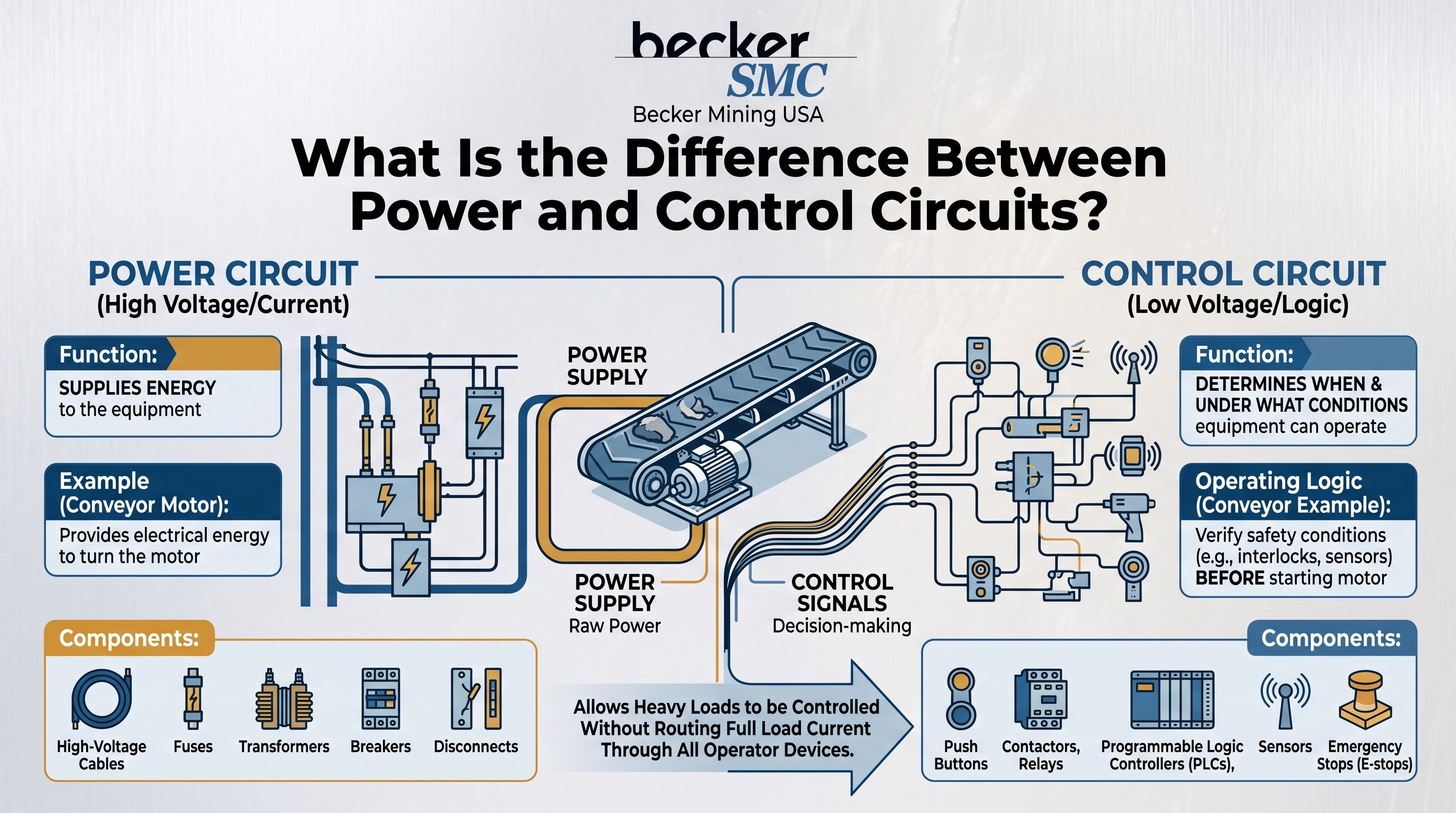
A power circuit supplies energy to the equipment, while a control circuit determines when and under what conditions that equipment is allowed to operate.
That distinction is fundamental to understanding mine electrical systems.
Consider a conveyor motor. The main power circuit provides the electrical energy that turns the motor. The control side may include push buttons, relays, contactors, programmable logic controllers, sensors, interlocks, emergency stops, and other devices.
An operator may press a start command, but that does not necessarily mean the motor should energize immediately. The control system may first have to verify that required safety conditions are satisfied.
The control circuit is therefore more than an on/off switch. It can establish operating logic.
For example, a system may be arranged so one machine cannot start until another piece of equipment is running, or so a circuit shuts down when a protective condition is detected.
That separation between power delivery and operating logic allows heavy electrical loads to be controlled without routing the full load current through every operator control or sensing device.
GET IN TOUCH
In a hurry? Call us at 276-285-3841
Why Grounding and Ground-Fault Protection Matter in Mines
Grounding provides a controlled electrical path during fault conditions, while ground monitoring and protective devices help detect problems that could otherwise expose people and equipment to dangerous electrical conditions.
This is especially important in mining because electrical equipment may operate in demanding environments while being connected through long cable runs and portable or mobile distribution arrangements.
For underground coal mining in the United States, federal provisions require grounding arrangements and protective devices for specified high-, medium-, and low-voltage circuits. Certain resistance-grounded systems also require continuous ground-check monitoring capable of opening the circuit when grounding continuity is lost.
MSHA's technical resources likewise identify grounding, ground-resistance testing, ground-check monitoring, and substation grounding and bonding as important subjects in mine electrical safety.
Ground monitoring adds another layer of protection. Becker/SMC ground-monitoring equipment is designed to monitor grounding conductor integrity and detect ground-fault conditions in mining applications.
The important point is that grounding should be treated as part of the electrical system design, not something added after the distribution layout has already been determined.
Why Circuit Protection Must Be Coordinated
A mine does not simply need circuit breakers. It needs protection that works as a coordinated system.
Suppose a fault develops on one branch serving a particular machine. Ideally, protection closest to the fault clears the affected circuit while healthy parts of the mine electrical network remain energized where safe and permitted.
If protection is poorly coordinated, a downstream fault can potentially cause a much broader interruption.
That makes several questions important:
Where is the fault likely to occur?
Different sections of the distribution system may have different available fault currents and operating conditions.
Which protective device should respond first?
The device nearest the fault generally needs to clear it without unnecessarily opening upstream protection, subject to the engineering and safety requirements of the system.
How quickly must it operate?
Fault-clearing time affects equipment exposure and electrical hazards.
What happens after the trip?
Monitoring and indication should help qualified personnel determine why the circuit opened rather than simply resetting equipment without understanding the cause.
Good protection is not measured by how often a breaker trips. It is measured by whether the right device responds to the right condition.
How Should a Mine Approach Power-Control Design?
A mine should start by defining its loads and operating requirements before selecting individual pieces of electrical equipment.
The equipment list alone does not describe the system.
Engineers also need to know where each load is located, how it operates, how often it starts, whether speed control is required, what other equipment depends on it, what happens if it loses power, and which protective requirements apply.
From there, the electrical system can be considered as a connected path:
incoming power → switching and protection → voltage transformation → distribution → motor or equipment control → load
Grounding, monitoring, communications, and protective logic interact with that path rather than sitting outside it.
This system-level approach also makes future troubleshooting easier. When the relationship between upstream power, downstream loads, protection, and controls is clearly engineered and documented, electrical personnel have a better starting point when something changes.
Common Mine Electrical System Problems Are Often Connected
Electrical problems do not always stay confined to one component.
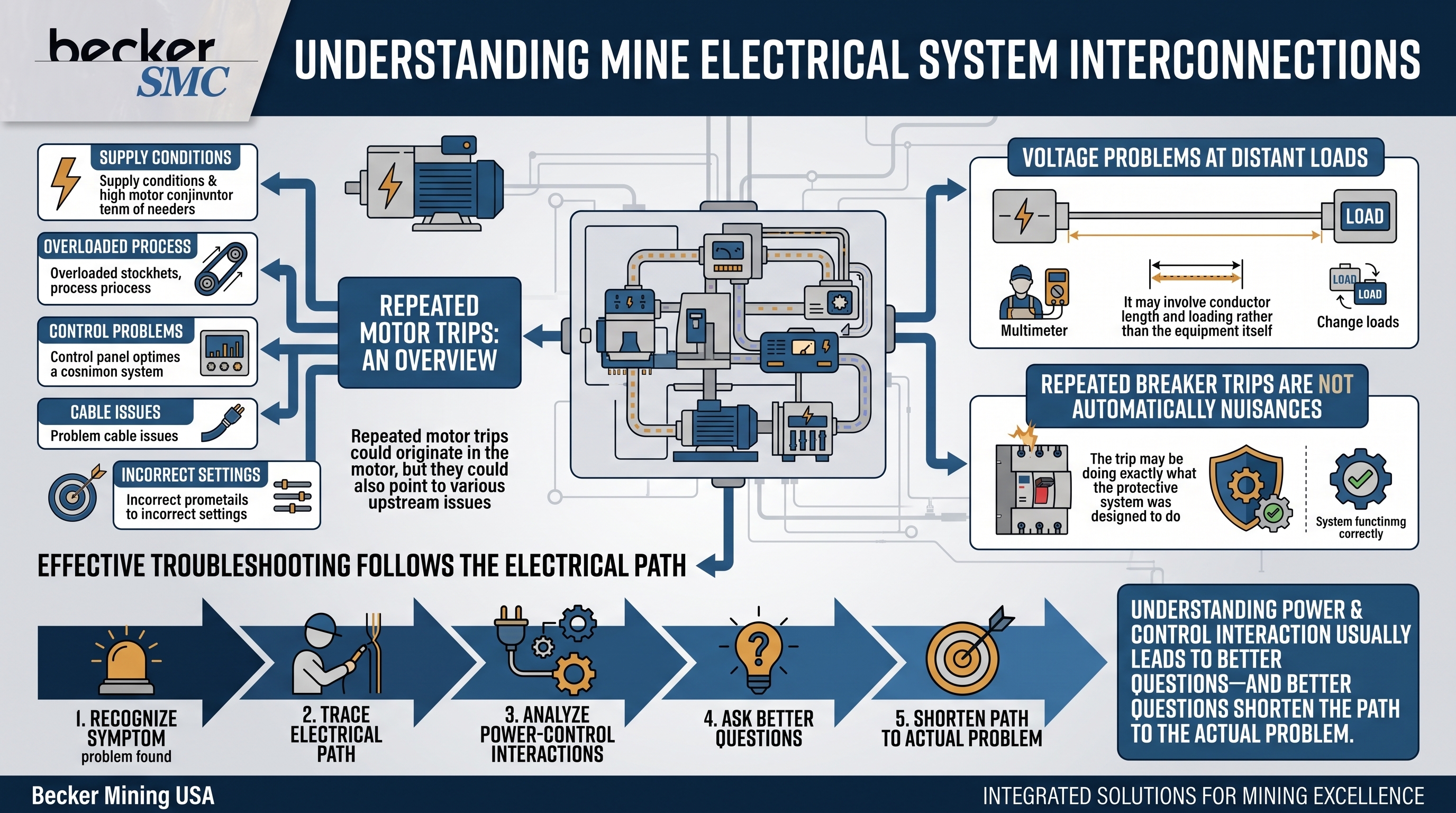
Repeated motor trips could originate in the motor, but they could also point to supply conditions, an overloaded process, control problems, cable issues, incorrect settings, or another upstream condition.
A voltage problem at a distant load may involve conductor length and loading rather than the equipment itself.
A breaker that repeatedly opens should not automatically be treated as a nuisance. The trip may be doing exactly what the protective system was designed to do.
That is why effective troubleshooting follows the electrical path instead of immediately replacing the component closest to the symptom.
Understanding how power and control interact usually leads to better questions—and better questions shorten the path to the actual problem.
GET IN TOUCH
In a hurry? Call us at 276-285-3841
Building Mine Electrical Systems Around the Operation
Mine electrical systems have to do several jobs at once. They need to deliver enough power for demanding equipment, control that equipment correctly, protect personnel and assets when something goes wrong, and give operators enough information to understand the system's condition.
Those requirements become harder as electrical loads grow and mining operations adopt more automation, monitoring, and electrically powered equipment.
At Becker/SMC, we manufacture electrical components, open-type and explosion-proof motor starters, longwall electrical controls, power distribution equipment, transformers, vacuum switches, connectors, monitoring equipment, and custom electrical solutions. Our focus is on building electrical equipment around the requirements of the application rather than treating mine power as a collection of unrelated components.
If you are evaluating a new mine electrical system, expanding an existing distribution network, or replacing equipment within a current system, contact Becker/SMC to discuss the electrical and control requirements of your operation.
Frequently Asked Questions
Q: What is a mine electrical system?
A: A mine electrical system is the equipment and infrastructure used to receive, transform, distribute, control, monitor, and protect electrical power throughout a mining operation. It can include switchgear, transformers, power centers, motor controls, cables, connectors, protection devices, grounding systems, and monitoring equipment.
Q: What does a mine power center do?
A: A mine power center transforms incoming electrical power to a voltage that downstream equipment can use and can incorporate distribution, switching, protection, metering, and monitoring functions. The exact arrangement depends on the mine and connected loads.
Q: What is the difference between a motor starter and a VFD?
A: A motor starter controls the starting and stopping of a motor. A VFD also controls motor speed and torque by varying the frequency and voltage supplied to the motor. VFDs are useful when the process requires adjustable speed or more precise motor control.
Q: Why is grounding important in mining electrical systems?
A: Grounding provides a path for fault current and supports the operation of protective systems. Depending on the mine type and applicable regulations, electrical systems can also require ground-fault protection and continuous monitoring of grounding conductor integrity.
Q: Why does mine power distribution need monitoring?
A: Monitoring can help electrical and maintenance personnel identify abnormal conditions, understand why equipment has tripped, track system behavior, and recognize developing problems. The value comes from using the measurements to support maintenance and operating decisions.
Products We Offer:
- Explosion Proof Equipment
- Transformers
- Arc Guard
- Longwall Electrical Systems
- Capacitor Trip Devices
- Electrical Equipments like capacitor banks, switch houses, junctions, and splice boxes.
Power up your productivity with Becker Mining's ground fault relays - the reliable and efficient solution for all your power distribution needs. Call us today!