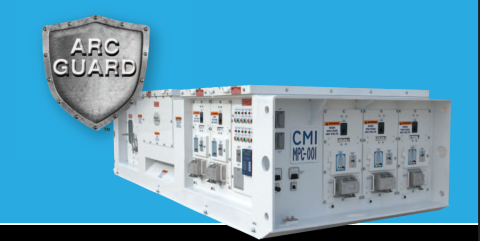
An electrician on a longwall section walks past the belt power center several times a shift. Inside that steel box, 995-volt and 4,160-volt circuits run a few inches apart. If a rodent, a loose tool or failed insulation starts an arc between them, the enclosure has to hold or redirect the blast. Standard underground power equipment is tested to hold up to bolted faults until a breaker clears them. Arcing faults behave differently. Arc guard protection controls where that energy goes. Becker Mining builds its Arc Guard power centers so the energy is directed away from the miners standing around the equipment.
Key Takeaways
- Arc guard protection covers personnel at the front, back and sides of the equipment.
- Arc Guard units are tested and classified as arc resistant to ANSI/IEEE C37.20.7-2007.
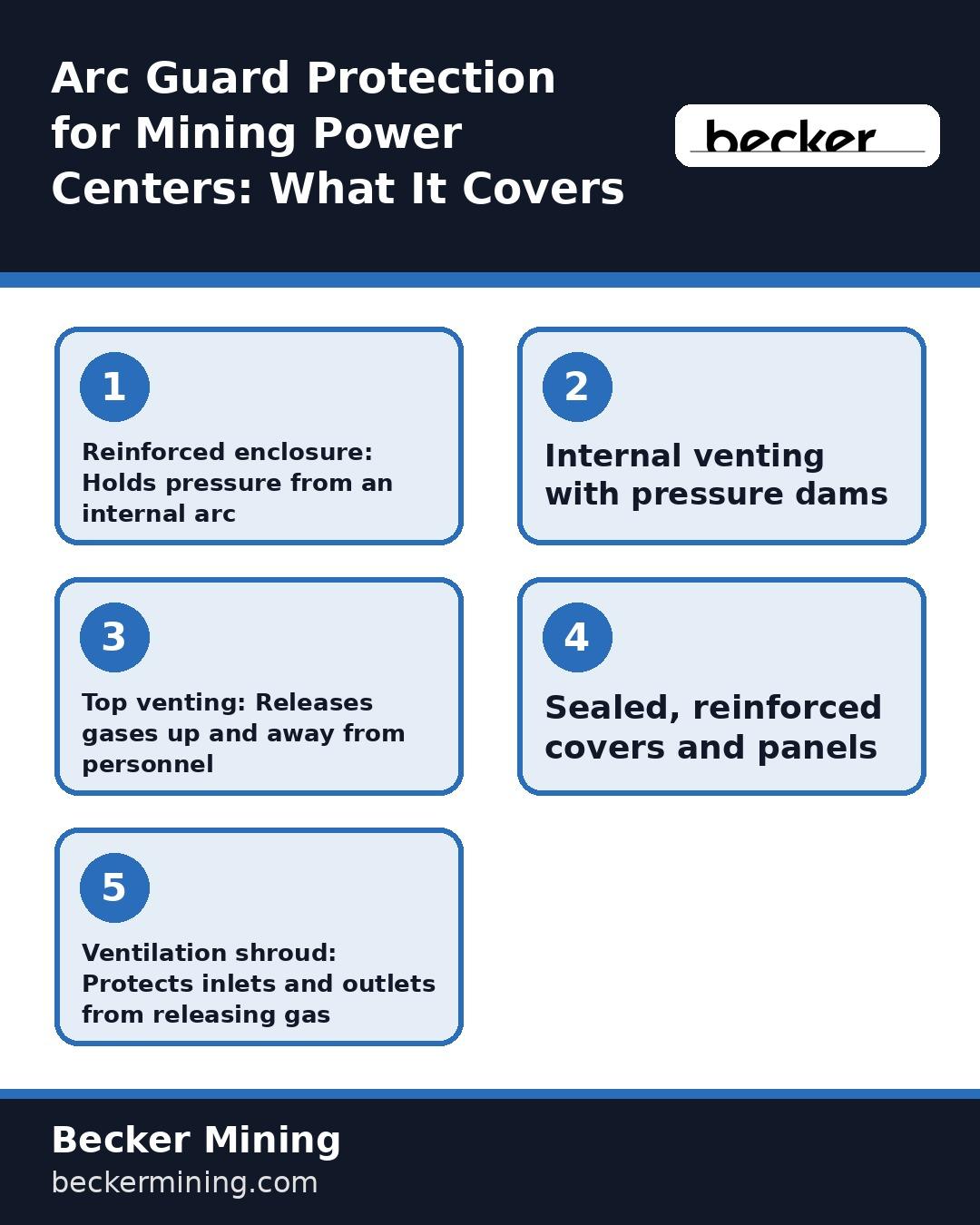
- Reinforced enclosures and internal pressure dams channel arc gases out the top.
- Arc resistance works alongside relays and safe work practices, not in place of them.
Why Is an Arcing Fault Different From a Bolted Fault?
In a bolted fault, two conductors touch solidly. Voltage at the fault point drops close to zero, and the fault current flows back to the source until a breaker opens. In an arcing fault, current jumps through the air between conductors. The arc can reach temperatures several times hotter than the surface of the sun. It heats the air inside the enclosure in a few milliseconds, and the pressure rises fast. That pressure can blow doors and covers open and throw hot gas, molten copper and debris outward. Equipment that passes bolted fault tests was never tested against that pressure.
What Does Arc Guard Protection Include?
|
|
|
|
|
|
|
|
|
|
|
|
|
|
|
|
|
|
IEEE C37.20.7 tests this by setting off an arc inside the equipment on purpose. Cotton indicator panels are placed around the enclosure at the height of a person. If any indicator ignites, or a door or panel opens, the unit fails. Arc Guard units passed that test and are classified as arc resistant.
GET IN TOUCH
In a hurry? Call us at 276-285-3841
Where Does It Fit in a Mine?
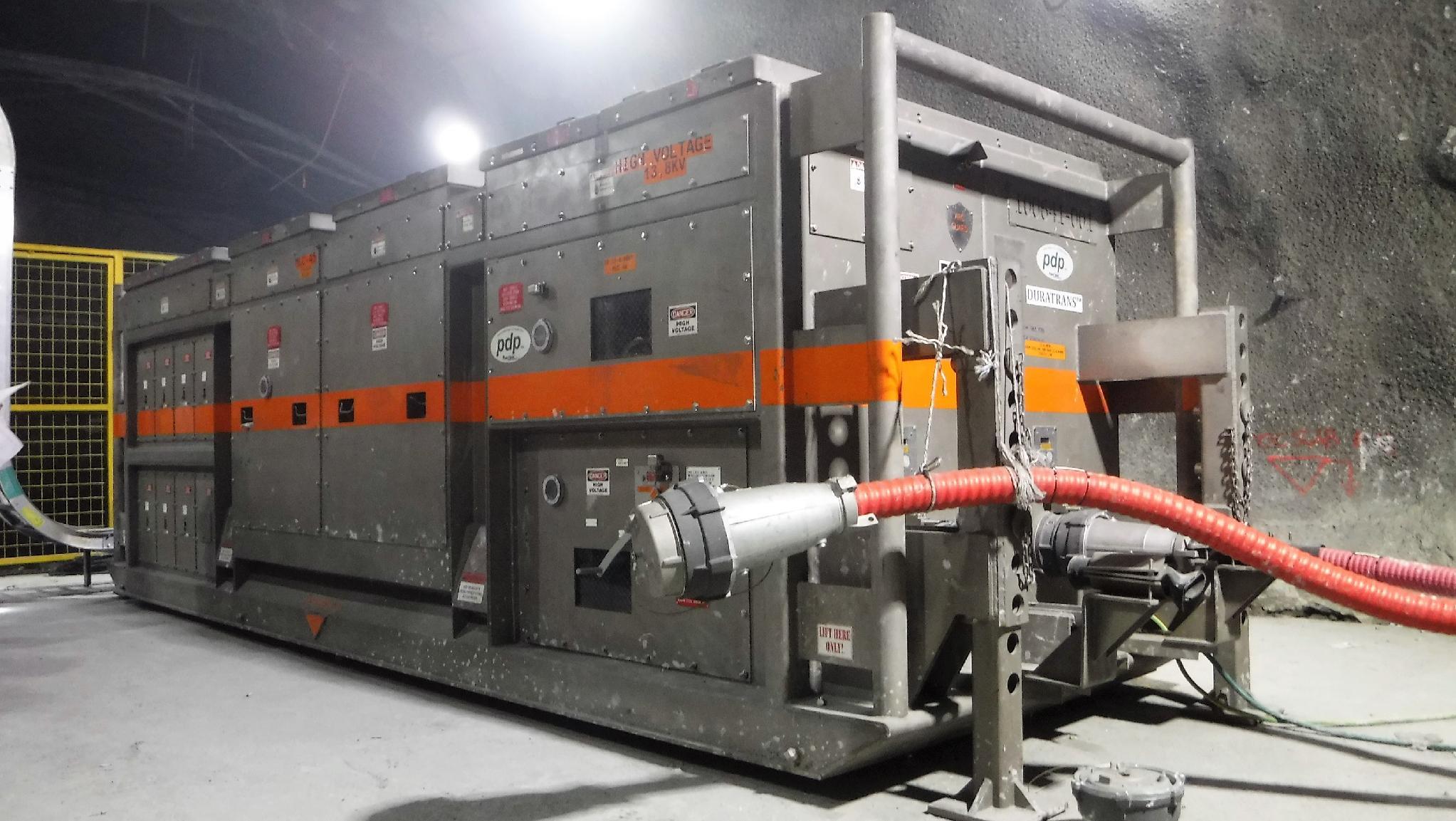
Belt and section power centers sit along travelways that miners pass every shift, which makes them the most common place for arc guard protection. It pairs well with arc flash relays. These relays use light sensors and current sensing to detect an arc and trip the upstream breaker within milliseconds. Faster clearing reduces the energy released, and the enclosure directs what remains away from people.
See the full Arc Guard product page, learn about arc flash relays in mines, and read why arc-resistant equipment matters underground. Our electrical equipment line covers the power centers themselves.
How Fast Must the Protection Act?
The energy released by an arc depends on the current flowing through it and how long it lasts. Doubling the clearing time roughly doubles the incident energy that reaches anyone standing nearby. That is why arc guard protection is built around speed. Conventional overcurrent relays are often set with deliberate time delays so that a breaker close to a fault trips before one further upstream. Those delays keep the rest of the system running, but they can let an arc burn for hundreds of milliseconds.
Arc detection takes a different approach. Light sensors mounted inside the switchgear compartments watch for the intense flash an arc produces. When a sensor sees that flash and a current sensor sees a rise in current at the same moment, the relay sends a trip signal in a few milliseconds. Requiring both signals keeps a camera flash or a sunbeam through an open door from causing a nuisance trip. The breaker's own opening time then becomes the largest part of the total clearing time.
Why Is Mining Equipment a Special Case?
Underground and surface mines run power at high voltages through portable equipment. Trailing cables feed shovels, continuous miners and drills that move every shift. Those cables are dragged, flexed and run over, so insulation damage is more common than in a fixed plant. Moisture, dust and vibration in switch houses and power centers add to the chance of a fault.
Crews also work close to energized gear. Electricians open power centers to reset breakers, check settings and troubleshoot equipment. When arc guard protection shortens clearing time, the incident energy at the working distance drops. That changes the arc flash labels on the equipment and can lower the category of protective clothing required for routine tasks.
How Is a System Tested and Maintained?
Each sensor and relay channel is checked at commissioning. Technicians shine a test light into each sensor and confirm the relay sees it on the right channel. A secondary injection test set feeds current into the relay to confirm it trips when light and current appear together. The trip circuit is then checked all the way to the breaker so the whole chain is proven.
After that, testing follows the maintenance schedule for the switchgear. Fiber optic sensors can get dirty or damaged when compartments are opened, and a dirty lens may not see a flash. Many relays supervise their sensor loops and raise an alarm when a fiber breaks. Records of each test give the mine a history to show inspectors and help plan replacements as equipment ages.
GET IN TOUCH
In a hurry? Call us at 276-285-3841
How Does It Fit With the Arc Flash Study?
An arc flash study calculates incident energy at each piece of equipment based on available fault current and clearing time. When arc guard protection is added, the study is updated using the faster clearing time. The revised results set new label values and boundaries. Becker's engineers can help mines align the protection settings, the study and the labels so the numbers on the door match the way the system actually behaves.
Talk With Our Engineers
Call Becker Mining at 276-285-3841 or contact us to review where arc guard protection fits in your power distribution.
Frequently Asked Questions
Q: Which standard is Arc Guard tested to?
A: It is performance tested and classified as arc resistant in accordance with ANSI/IEEE C37.20.7-2007.
Q: Does arc guard protection replace PPE?
A: No. It reduces exposure around the equipment, and required PPE and safe work practices still apply.
Q: Can existing power centers be upgraded?
A: Talk with our team. The answer depends on the existing enclosure and layout.
Products We Offer:
- Explosion Proof Equipment
- Transformers
- Arc Guard
- Longwall Electrical Systems
- Capacitor Trip Devices
- Electrical Equipments like capacitor banks, switch houses, junctions, and splice boxes.
Power up your productivity with Becker Mining's ground fault relays - the reliable and efficient solution for all your power distribution needs. Call us today!