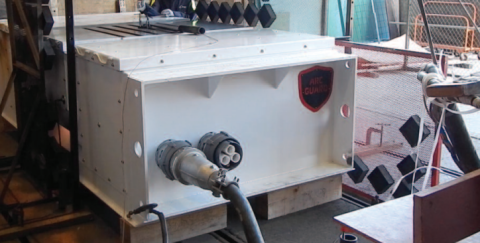
Arc faults can develop in seconds, but the consequences can affect a mine for far longer. An internal electrical arc can expose workers to extreme heat, pressure, molten material, and equipment damage while taking critical power-distribution assets out of service.
At Becker Mining USA, we manufacture electrical equipment for demanding mining environments, including our Arc Guard® Power Center. Our documented Arc Guard design takes an arc-resistant approach: reinforced construction and controlled venting are used to manage the pressure and hot gases produced by an internal arcing fault and direct them away from personnel during normal operating conditions.
That distinction matters. An industrial arc guard solution is not necessarily one device or one detection method. Effective mine electrical protection may combine arc-resistant equipment, properly coordinated protective devices, fault detection, safe work procedures, and an arc-flash hazard assessment based on the actual electrical system.
Key Takeaways
- Industrial arc guard protection can reduce worker exposure to the pressure, heat, and debris associated with internal electrical arcing faults.
- Becker’s Arc Guard Power Center uses reinforced arc-resistant construction and internal venting to direct arc-fault gases away from personnel.
- Arc-resistant containment and high-speed electronic arc detection solve different parts of the problem and may be used together depending on the mine’s electrical design.
- continues to emphasize de-energization, lockout/tagout, proper electrical PPE, grounding, and safe work procedures as essential controls around mine electrical equipment.
- Arc-flash protection should be engineered around fault current, equipment configuration, clearing time, operating voltage, maintenance practices, and worker exposure rather than selected from a single specification.
Why Arc-Flash Protection Matters in Mining
Mining electrical systems operate under conditions that can be harder on equipment than many conventional industrial environments. Dust, moisture, vibration, contamination, heavy loads, cable damage, aging insulation, and foreign material can all contribute to electrical faults.
An internal arc can occur when electricity establishes an unintended path through air. Becker’s Arc Guard documentation identifies insulation degradation, contamination, water intrusion, and foreign objects contacting energized buswork as possible causes. During an arcing fault, energy can become concentrated inside the equipment, rapidly heating the surrounding air and creating severe thermal and mechanical stress.
Becker’s product literature notes that arc temperatures can exceed 35,000°F. The resulting pressure can damage covers, doors, panels, and other enclosure components if the equipment is not designed to manage an internal arc.
The danger is not theoretical. has published safety alerts documenting miners injured in electric arc-flash incidents during tasks involving power lines, breaker boxes, transformers, and other electrical equipment. Its recommended practices include de-energizing equipment, locking and tagging circuits, grounding de-energized conductors, and using properly rated protective equipment.
What Is an Industrial Arc Guard?
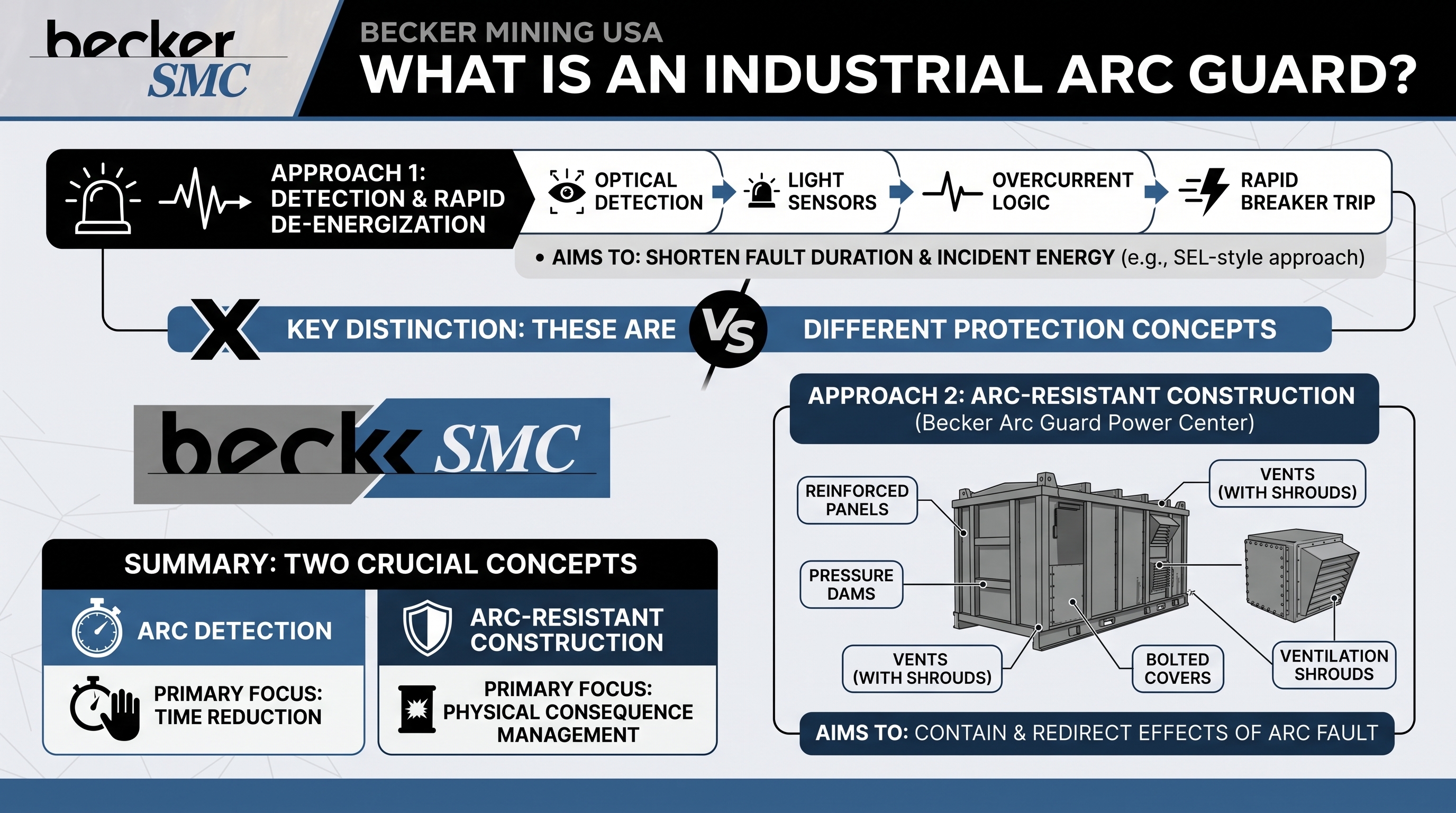
An industrial arc guard is a protection approach intended to reduce the consequences of an internal electrical arc. Depending on the system, protection may involve arc-resistant enclosures, pressure management, protective relays, optical detection, rapid breaker operation, or a combination of these controls.
This is where terminology can become confusing.
Some arc-flash mitigation systems use light sensors and overcurrent logic to detect a developing arc and command a breaker to trip quickly. SEL, for example, describes an approach that combines light sensing with fast overcurrent protection to reduce clearing time and incident energy.
The documented Becker Arc Guard Power Center uses a different primary protection strategy. Its product documentation describes an arc-resistant enclosure with reinforced panels, pressure dams, vents, bolted covers, and ventilation shrouds designed to contain and redirect the effects of an internal arcing fault.
Neither concept should be confused with the other. Detection aims to shorten the duration of a fault. Arc-resistant construction is intended to manage the physical consequences if an internal arc occurs.
GET IN TOUCH
In a hurry? Call us at 276-285-3841
How Becker Arc Guard Power Centers Manage Internal Arc Energy
Our Arc Guard Power Center is designed around containment and pressure control.
The enclosure is reinforced to withstand pressure generated by internal arcing faults. Within the equipment, pressure dams and vents create a controlled path for expanding gases. Rather than allowing those gases to escape unpredictably through doors or panels, the design directs them upward and away from personnel around the equipment. Reinforced and sealed panels, bolted covers, and ventilation shrouds contribute to the overall arc-resistant structure.
Becker’s Arc Guard documentation states that the equipment was performance tested and classified as arc resistant in accordance with ANSI/IEEE C37.20.7-2007. Because that reference identifies the edition used for the documented testing, mine operators evaluating a new project should confirm the applicable specification, current project requirements, and required test classification for their particular installation rather than assuming an older test reference automatically satisfies every current design requirement.
That is especially important when equipment specifications are being written for a new power center, switchgear replacement, expansion, or modernization project.
Arc-Resistant Equipment vs. High-Speed Arc Detection
Arc-resistant equipment and high-speed fault detection address different variables in arc-flash risk.
High-speed detection attempts to recognize an arc rapidly and initiate interruption. The shorter the arcing duration, the lower the incident energy can be in many system configurations. SEL’s mining case study describes a North American operation where light and overcurrent-based arc-flash detection was used with protective relays and where the operator reported substantially reduced incident energy during an actual event.
Arc-resistant equipment assumes that an internal arc can still occur. Its job is to control the resulting pressure, gases, and debris within the limitations of the tested equipment configuration.
For a mine electrical engineer, this should not necessarily be an either-or decision. The appropriate design depends on the fault current available, breaker clearing time, equipment rating, switchgear arrangement, accessibility, maintenance requirements, and the locations where personnel may be present.
A high-speed relay cannot make weak equipment mechanically arc resistant. Likewise, a reinforced enclosure does not replace proper protective-device coordination or safe electrical work practices.
Where Arc Guard Protection Fits in a Mine Power System
Arc-flash protection is most effective when treated as part of the mine’s broader power-distribution strategy.
Designs and manufactures electrical components, motor starters, longwall controls, power-distribution equipment, transformers, switches, connectors, and monitoring devices for mining and other industrial applications. The company was established in 1971 and today operates from Bristol, Virginia, with more than 90,000 square feet of manufacturing space.
That system-level perspective matters because arc risk does not stop at one enclosure. Power centers, switchgear, transformers, motor-control equipment, cables, protective relays, and downstream loads all influence how a fault develops and how quickly it can be isolated.
For example, changing a breaker setting to improve selectivity can also affect fault-clearing time. Adding equipment may change available fault current. Replacing a transformer can alter system characteristics. A modification that looks small on a single-line diagram may therefore affect arc-flash calculations elsewhere in the distribution system.
What Should a U.S. Mine Evaluate Before Selecting Arc Guard Equipment?
The right industrial arc guard configuration depends on the electrical system and the work performed around it.
Start with the operating voltage and available fault current. Then look at breaker or relay clearing times, the physical configuration of the equipment, access around the enclosure, expected operating tasks, and whether workers may be positioned in front of, beside, or behind energized equipment during normal operation.
Maintenance practices matter too. Loose connections, contamination, damaged insulation, water intrusion, and foreign objects can increase fault risk. Arc-resistant construction provides an additional layer of protection, but it does not remove the need to keep electrical equipment clean, properly maintained, and operated within its ratings.
The condition of existing equipment can also change the decision. Older switchgear may lack pressure relief or controlled venting. A mine planning a major electrical upgrade should consider whether replacing individual protective components is sufficient or whether the enclosure itself should also be upgraded.
How IEEE Arc-Flash Analysis Fits Into the Decision
IEEE 1584 and arc-resistant equipment standards serve different purposes.
IEEE 1584-2018 is an active guide for calculating predicted incident thermal energy and arc-flash boundaries for covered three-phase AC systems. IEEE states that its models apply to systems from 208 V through 15 kV within the scope of the guide.
That analysis helps engineers understand the potential worker exposure at electrical equipment.
By contrast, IEEE C37.20.7 deals with testing metal-enclosed switchgear for internal arcing faults. Becker’s Arc Guard documentation references ANSI/IEEE C37.20.7-2007 for its arc-resistant classification.
These are related safety considerations, but they are not interchangeable. A mine can have an arc-flash study and still need to evaluate whether equipment construction adequately manages an internal arc. It can also install arc-resistant equipment without eliminating the need for electrical hazard analysis and safe work procedures.
Can Arc Guard Protection Reduce Mine Downtime?
Arc guard protection can help limit the extent of damage caused by an internal arcing event, which may reduce the amount of equipment requiring repair or replacement. The actual downtime after a fault, however, depends on where the fault occurred, the equipment damaged, spare-part availability, inspection requirements, and whether adjacent sections of the electrical system were affected.
That is why selective isolation matters.
A well-designed protection system should clear the affected portion of the network without unnecessarily removing power from unrelated loads whenever the electrical design allows it. Limiting damage to one compartment or one section of switchgear can make recovery much more manageable than dealing with widespread electrical and fire damage.
The business case is therefore broader than replacement cost. Mine operators also need to consider lost production, troubleshooting time, emergency repairs, equipment lead times, investigation requirements, and the consequences of taking critical ventilation, pumping, conveying, or production equipment offline.
Arc Guard Does Not Replace Safe Electrical Work Practices
No arc-resistant enclosure should be treated as permission to work unnecessarily on energized equipment.
’s current arc-flash guidance emphasizes planning work in advance, knowing how to disconnect electrical systems, opening the appropriate breakers or load-break switches, verifying isolation, applying lockout/tagout, grounding de-energized conductors, and using properly rated electrical PPE.
Arc-resistant equipment is another layer of protection. It does not replace qualified personnel, electrical maintenance, hazard assessments, PPE, grounding, lockout/tagout, or the mine’s established safety procedures.
The goal is layered risk reduction.
Why Mining-Specific Equipment Design Matters
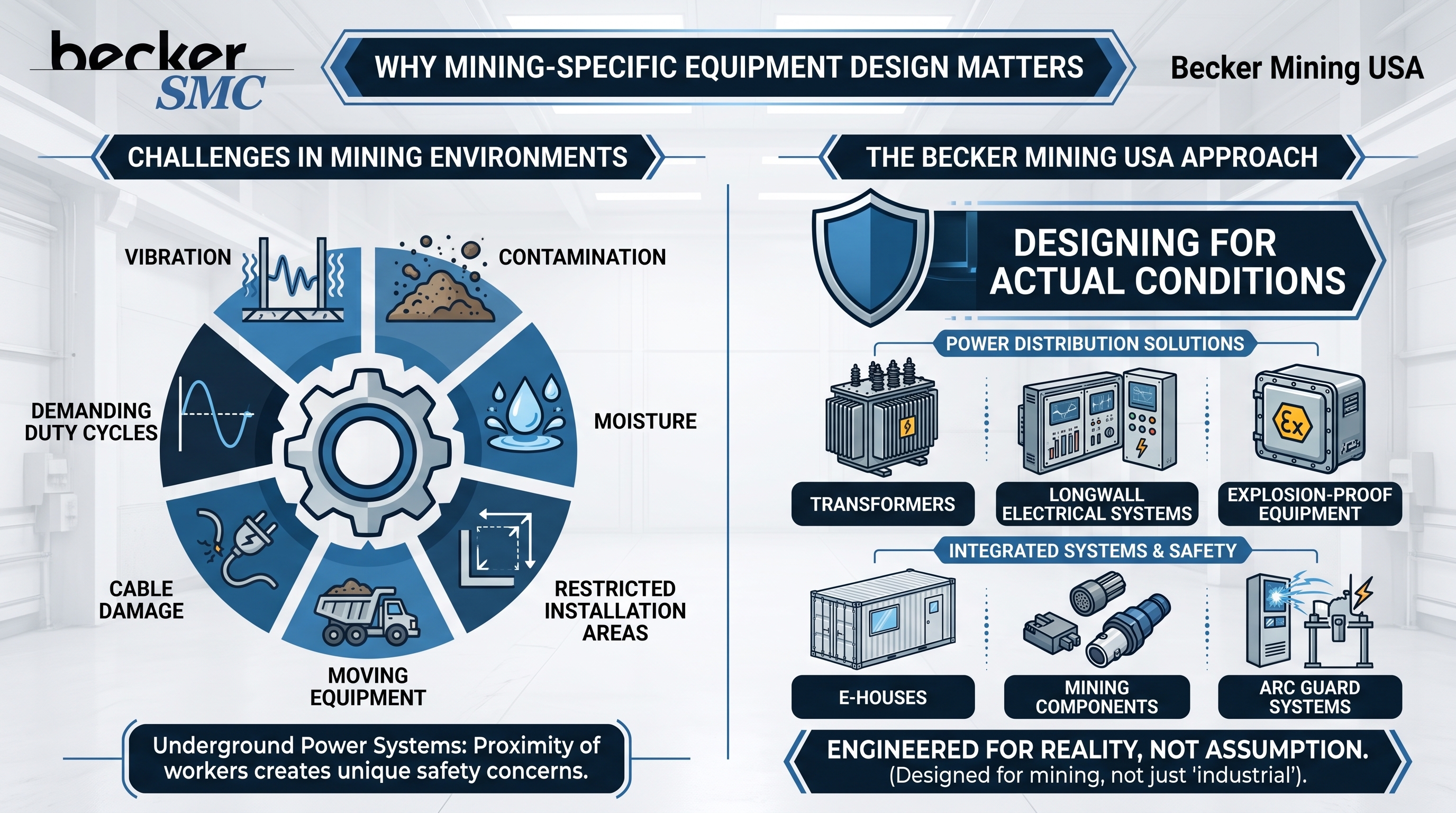
Mining equipment has to work in environments where ordinary industrial assumptions may not hold.
Electrical assemblies can be exposed to vibration, contamination, moisture, restricted installation areas, moving equipment, cable damage, and demanding duty cycles. Underground power systems can also place workers in closer proximity to electrical equipment than would be typical in a large above-ground utility installation.
For that reason, we design mining power equipment around the conditions in which it will actually be used rather than treating the mine as a conventional industrial plant.
Manufactures power-distribution equipment and other electrical products for mining applications, including transformers, longwall electrical systems, explosion-proof equipment, E-Houses, mining components, and Arc Guard systems.
GET IN TOUCH
In a hurry? Call us at 276-285-3841
Choosing an Industrial Arc Guard Solution for Your Mine
An industrial arc guard should be selected as part of the mine’s electrical protection architecture, not as an isolated accessory.
Before specifying equipment, review the system one-line, available fault current, operating voltage, protective-device settings, equipment accessibility, arc-flash study results, environmental conditions, and the operating or maintenance tasks workers perform nearby.
For existing mines, also consider what is already installed. A retrofit strategy for aging switchgear may be very different from the design of a new underground power center. In some applications, faster detection may be the priority. In others, arc-resistant containment may address a significant weakness in the existing system. Larger projects may justify both.
At Becker Mining USA, we can work with mine operators and electrical teams to evaluate power-distribution requirements and determine where Arc Guard equipment fits within the broader system.
Build Arc-Flash Protection Into the Power System
Arc-flash risk cannot be managed with one component alone. The strongest approach combines properly engineered equipment, fault protection, electrical studies, maintenance, and disciplined work procedures.
Our Arc Guard Power Center adds arc-resistant construction to that strategy by reinforcing the enclosure and directing internal arc-fault gases away from personnel. For mines evaluating new power-distribution equipment or replacing older gear, we can help determine how Arc Guard technology fits the electrical requirements of the operation.
Frequently Asked Questions
Q: What does an industrial arc guard do?
A: An industrial arc guard reduces the hazards associated with electrical arcing faults. Depending on the equipment, it may detect and interrupt an arc rapidly, contain the fault within an arc-resistant enclosure, redirect hot gases away from workers, or combine several protection methods.
Q: Is Becker Arc Guard an optical arc-flash detection system?
A: Becker’s Arc Guard Power Center product documentation describes an arc-resistant mechanical enclosure system rather than relying on optical detection as its primary protective method. The documented features include reinforced construction, pressure dams, pressure vents, sealed panels, bolted covers, and ventilation shrouds.
Q: What causes arc faults in mining electrical equipment?
A: Internal arcing faults can develop from insulation degradation, contamination, water intrusion, foreign material contacting energized components, damaged conductors, or other conditions that create an unintended electrical path through air.
Q: Does arc-resistant equipment eliminate the need for PPE?
A: No. Arc-resistant equipment does not eliminate electrical hazards or replace safe work practices. recommends de-energization, lockout/tagout, grounding, properly rated electrical test equipment, and appropriate protective equipment for electrical work.
Q: What is the difference between IEEE 1584 and arc-resistant switchgear testing?
A: IEEE 1584 provides methods for estimating incident energy and arc-flash boundaries for electrical systems within its scope. Arc-resistant switchgear testing evaluates how equipment performs during an internal arcing fault. The two address different parts of electrical safety.
Q: Can Arc Guard be used in an existing mine?
A: Potentially. The practical approach depends on the existing switchgear, electrical ratings, available fault current, physical space, protection scheme, and whether replacement or retrofit work is planned. A system-level review should come before selecting equipment.
Products We Offer:
- Explosion Proof Equipment
- Transformers
- Arc Guard
- Longwall Electrical Systems
- Capacitor Trip Devices
- Electrical Equipments like capacitor banks, switch houses, junctions, and splice boxes.
Power up your productivity with Becker Mining's ground fault relays - the reliable and efficient solution for all your power distribution needs. Call us today!