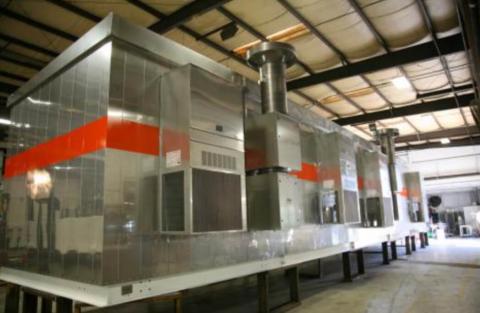
An underground mine does not simply need electricity. It needs power delivered at the right voltage, with the right protection, close enough to operating equipment to remain practical as mining advances.
That is where the mine power center becomes critical.
A properly designed power center transforms and distributes electrical power while helping protect personnel, cables, machinery, and downstream circuits from electrical faults. Underground conditions make that job harder. Long feeder distances, changing equipment locations, restricted space, dust, moisture, vibration, and demanding loads all have to be considered before the power center is built.
At Becker/SMC, we design and manufacture electrical controls, transformers, power distribution equipment, and complete electrical systems for mining applications. Our history in this work dates to 1971, and our custom equipment operation allows us to engineer equipment around customer specifications and regulatory requirements.
Key Takeaways
- A mine power center must do more than step voltage down; its design affects fault protection, equipment performance, maintenance access, and operational continuity.
- Transformer size, impedance, cable length, connected load, and available fault current all influence how the electrical system behaves underground.
- Ground-fault, grounded-phase, short-circuit, and overcurrent protection are important parts of underground mine electrical safety and, in applicable U.S. coal-mine installations, are addressed by MSHA requirements.
- Rugged construction matters because underground electrical equipment is routinely exposed to contaminants, vibration, moisture, handling, and physical movement.
- A power center should be designed around the actual mine layout and equipment load rather than treated as a generic transformer package.
- As the working section moves, power distribution must remain practical. A suitable footprint and configuration can make relocation and cable management easier without compromising electrical requirements.
What Is a Mine Power Center?
A mine power center, sometimes called a load center, is an underground electrical distribution unit that typically receives higher-voltage mine power, transforms it to the voltage needed by mining machinery, and provides switching and protective functions for downstream equipment.
The exact configuration depends on the mine and connected loads.
Becker/SMC power centers used in longwall systems range from 1,000 kVA to 12 MVA, with primary voltage options up to 35 kV. Depending on motor requirements, longwall systems may use input voltages from 995 to 4,160 VAC or combinations of voltages.
For other mining applications, power centers may convert inputs in the roughly 5 kV to 25 kV range to outputs around 480 to 1,000 volts.
Those numbers illustrate an important point: there is no single mine power center configuration that suits every underground operation. The design has to match the electrical system around it.
Why Does Mine Power Center Design Matter?
Mine power center design matters because the power center sits between a high-energy distribution system and equipment operating in a difficult environment. Decisions made at the design stage affect how faults are cleared, how voltage reaches machinery, how safely equipment can be serviced, and how easily the electrical system can adapt as mining progresses.
A power center that is poorly matched to its application may still deliver electricity, but that does not mean the overall system is well designed.
Five areas deserve particular attention.
1. Electrical Protection Starts With the System Design
Electrical protection cannot be added as an afterthought.
Underground distribution systems need protective devices coordinated with the available fault current, transformer characteristics, cable impedance, system grounding, and connected equipment. The objective is to detect abnormal conditions and isolate the affected circuit before the problem causes additional damage or creates unnecessary exposure.
For underground U.S. coal mines, MSHA requirements address protection against conditions including undervoltage, grounded phase, short circuit, and overcurrent on applicable high-voltage circuits. MSHA guidance also discusses ground-check circuits and grounded-phase protection for underground systems.
Grounding and Ground-Fault Protection
Resistance grounding is especially important in many mine power systems.
The neutral grounding resistor limits fault current while giving the protection system a measurable condition it can use to detect a ground fault. Under applicable federal underground coal-mine requirements, certain high-voltage circuits use a grounded neutral through a suitable resistor, with a grounding conductor extending with the power conductors.
A well-designed system therefore considers more than whether a ground-fault relay is present. Engineers also have to consider the grounding resistor, relay settings, continuity of the grounding circuit, cable arrangement, and how the protection scheme behaves during an actual fault.
That is the difference between specifying individual components and engineering a system.
Short-Circuit Current Matters Too
Protective equipment has to be capable of interrupting the fault current the system can actually produce.
MSHA's technical guidance on mine electrical systems shows that short-circuit calculations can include utility supply characteristics, substation transformers, mine feeder cable, power center transformer impedance, and trailing cable length.
Change one of those variables and the available fault current can change as well.
That means a power center cannot be evaluated only by its kVA rating or secondary voltage. Its transformer impedance and its position within the larger mine distribution network also matter.
2. Transformer Selection Affects More Than Voltage
One of the main jobs of a mine power center is straightforward: convert distribution voltage to a level the connected equipment can use.
The engineering behind that task is less simple.
Transformer selection affects voltage regulation, available short-circuit current, thermal performance, physical size, and the loads that can be supported. A transformer that is incorrectly sized for the application can create avoidable operational problems even when the nominal primary and secondary voltages appear correct.
Engineers need to understand questions such as:
- What equipment will the power center supply?
- What are the continuous and starting loads?
- How far is the power center from the source and the operating equipment?
- What voltage drop will occur through the feeder and trailing cables?
- What transformer impedance is appropriate?
- Are additional loads likely to be added later?
- How frequently will the power center be relocated?
Those questions are connected.
For example, MSHA's short-circuit calculation handbook gives an example of an underground power system in which power passes through a substation, 6,000 feet of mine power feeder cable, a 1,350 kVA power center transformer, and another 850 feet of trailing cable before reaching a continuous miner.
That type of layout shows why underground power cannot be treated as a nameplate-voltage problem. Cable length and transformer characteristics are part of the electrical design.
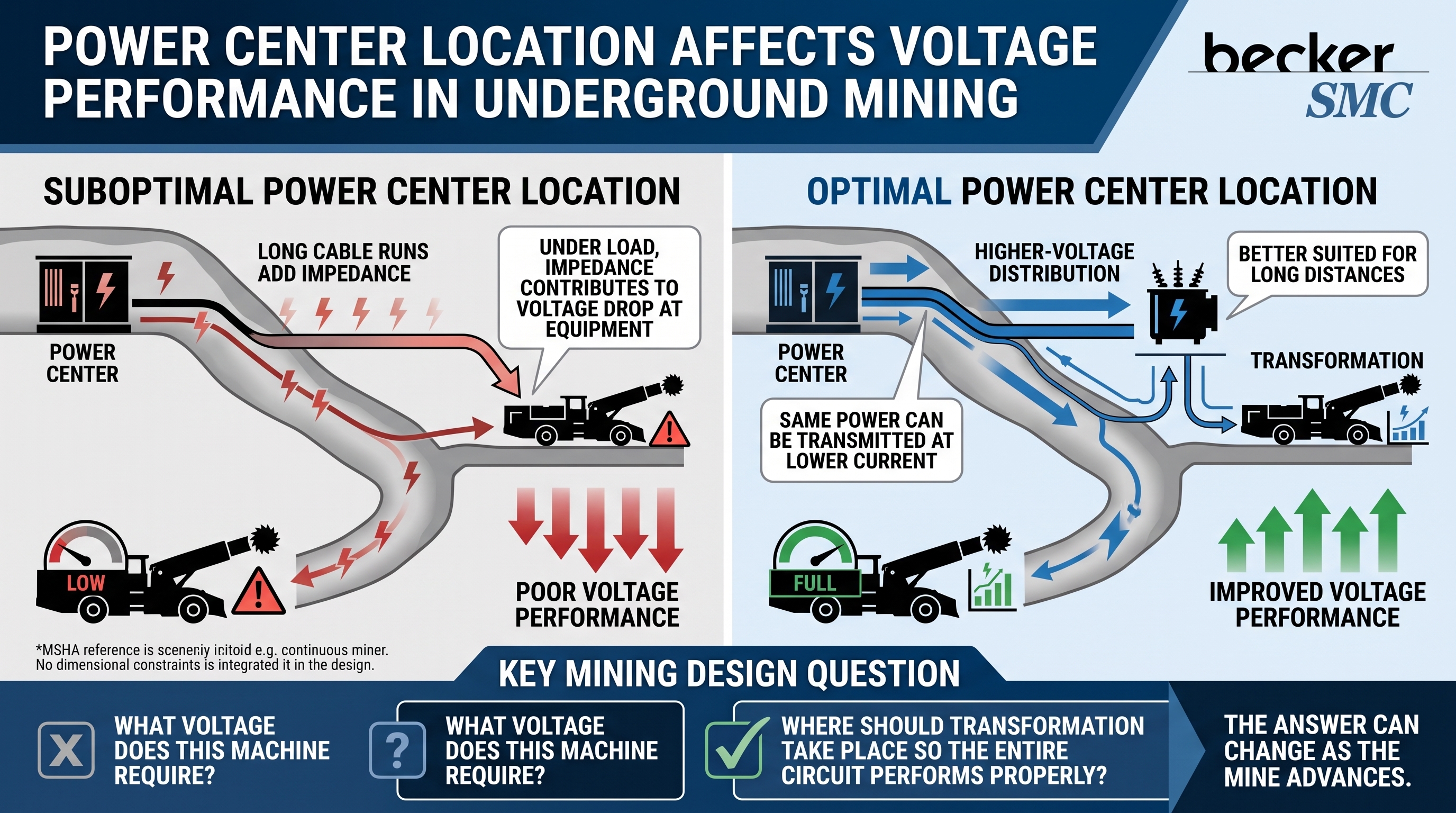
3. Power Center Location Can Affect Voltage Performance
As an underground mine develops, electrical loads may move farther from the original source.
Long cable runs add impedance. Under load, that can contribute to voltage drop at the equipment.
Locating transformation and distribution equipment closer to the working area can reduce the amount of lower-voltage power that must travel over long distances. Higher-voltage distribution is generally better suited to moving substantial power over longer distances because the same power can be transmitted at lower current.
MSHA technical material describes underground high-voltage distribution cables extending thousands of feet to distant mining sections, illustrating how significant mine electrical distances can become.
The practical design question is therefore not simply, “What voltage does this machine require?”
It is also, “Where should transformation take place so the entire circuit performs properly?”
That answer can change as the mine advances.
GET IN TOUCH
In a hurry? Call us at 276-285-3841
4. Underground Equipment Needs Mechanical Durability
Electrical performance is only half of the design problem.
A mine power center also has to survive underground.
Equipment may be exposed to dust, moisture, vibration, contaminants, impacts, repeated handling, and the physical demands of moving electrical infrastructure as operations progress.
That makes enclosure construction, transformer construction, skid design, coatings, component mounting, cable connections, and internal separation practical engineering concerns rather than cosmetic details.
We build underground power centers for these operating conditions. Becker power centers use heavy-duty construction, and our underground designs can incorporate neutral grounding resistors and custom configurations based on the application.
Our transformer engineering addresses the same problem. For example, our Duratrans™ transformer technology is designed around harsh mining environments, with construction intended to strengthen the winding assembly and help seal environmental contaminants out of the transformer.
A standard industrial transformer may perform well in the environment for which it was designed. Underground mining presents a different set of mechanical and environmental demands.
The power center needs to reflect that reality.
5. Physical Layout Influences Maintenance and Safety
A good power center layout should make the electrical system easier to understand, isolate, inspect, and maintain.
Depending on the design, features may include physical separation between high-voltage switching and transformer sections, visible status indication, interlocking arrangements, emergency controls, grounded compartments, protective relays, and barriers intended to limit access to energized components.
These details matter because underground maintenance often takes place where space is limited and several electrical functions are packaged within a relatively compact footprint.
The design should make equipment status as clear as practical.
Historical MSHA accident investigations also show why correct isolation and clear identification of energized equipment matter. In one fatal electrical accident, confusion over the electrical source and equipment status contributed to work being performed on an energized high-voltage circuit.
No enclosure feature replaces proper electrical procedures, qualification, lockout, grounding, or testing. Good design supports those practices rather than relying on workers to compensate for an unclear equipment layout.
Why Portability Matters as the Mine Advances
Underground power distribution is rarely static.
The active mining area changes. Equipment moves. Cable runs change. Loads may be added or reassigned. A power center that works well in one location may eventually need to follow the production area.
That makes physical size and mobility part of power-center engineering.
A portable or skid-mounted design has to balance competing needs. It must be compact enough for the mine's transportation and clearance limits while still providing room for transformers, switches, protective devices, cable terminations, barriers, and maintenance access.
Making the enclosure smaller is not automatically better.
The correct footprint is one that fits the mine while preserving the electrical, mechanical, thermal, and service requirements of the equipment inside it.
What Happens When Several Design Variables Change at Once?
This is where mine power center engineering becomes more important.
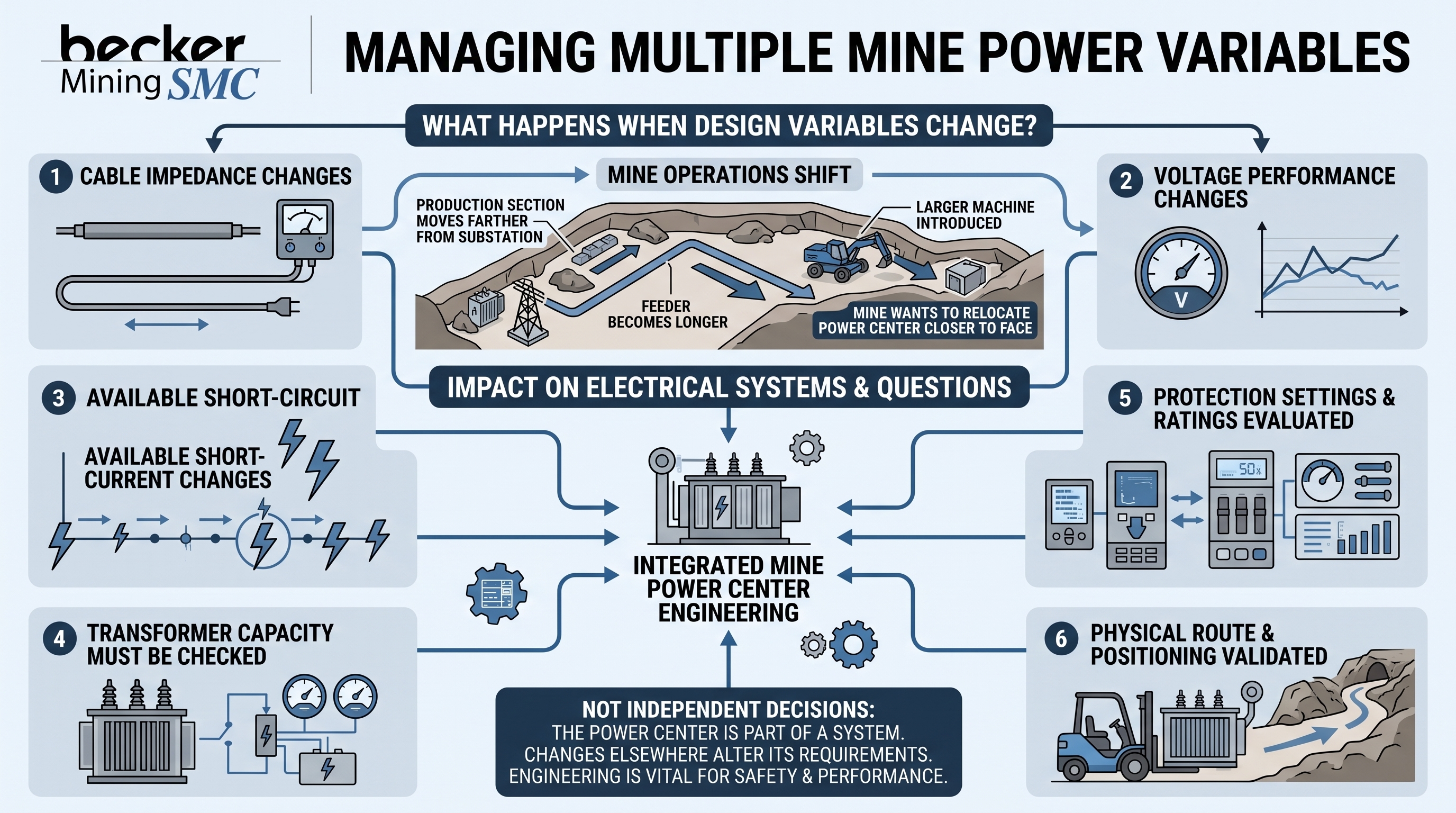
Suppose a production section moves farther from the substation. The feeder becomes longer, a larger machine is introduced, and the mine wants to relocate the power center closer to the face.
That single operational change can affect several electrical questions:
Cable impedance changes. Voltage performance may change. Available short-circuit current at different points in the system can change. Transformer capacity needs to be checked against the new load. Protection settings and interrupting ratings may need to be evaluated. The physical route for moving and positioning the power center also has to work.
These are not independent decisions. The power center is part of a system, and changes elsewhere in the mine can alter what the power center needs to do.
GET IN TOUCH
In a hurry? Call us at 276-285-3841
Mine Power Center Design vs. General Mine Power System Design
A mine power system covers the larger network used to deliver electricity across the mining operation. It can include utility or generated power, substations, switchgear, distribution cables, transformers, power centers, motor controls, and the equipment using that power.
The mine power center has a more specific role.
It is one of the points where the broader distribution system is transformed into usable, protected power for a particular group of underground loads.
That distinction matters. General discussions of mine power often focus on total energy availability, remote-site generation, ventilation, pumping, sustainability, or mine-wide infrastructure. Those subjects are important, but they do not answer the engineering questions surrounding the power center itself.
For underground crews and electrical engineers, details such as transformer impedance, secondary voltage, grounding, fault protection, cable distance, enclosure construction, and portability can have a more immediate effect on how a working section operates.
Build the Power Center Around the Mine
A mine power center is much more than a transformer on a skid. It is part of the underground electrical protection and distribution system, and its design influences the way power reaches equipment, how faults are handled, how the unit survives underground conditions, and how readily the electrical infrastructure can move with the operation.
At Becker/SMC, we have designed and manufactured mining electrical equipment for decades, including transformers, distribution equipment, electrical controls, and complete longwall electrical systems. Our Bristol, Virginia operation includes more than 90,000 square feet of manufacturing space, and we build equipment around customer specifications and applicable regulatory requirements.
If you are planning a new underground power distribution system, replacing an existing power center, or changing the loads on a working section, we can review the electrical and operating requirements with you and develop a configuration suited to the application. Contact us today!
Frequently Asked Questions
Q: What does a mine power center do?
A: A mine power center receives electrical power at a higher distribution voltage, transforms it to the voltage required by underground equipment, and provides switching, monitoring, grounding, and protective functions depending on the system design. It acts as a key connection point between the mine distribution network and operating machinery.
Q: What voltage does a mine power center use?
A: There is no single voltage used by every mine power center. Becker/SMC has described mining power centers with inputs in the 5 kV to 25 kV range and outputs around 480 to 1,000 volts for certain applications. Our longwall systems can use primary voltages up to 35 kV and inby voltages from 995 to 4,160 VAC depending on motor requirements.
Q: Why are ground-fault protection and grounding important underground?
A: Grounding and ground-fault protection help provide a controlled path for fault current and allow protective devices to detect abnormal electrical conditions. In applicable underground coal-mine systems, MSHA requirements address resistance grounding, ground-check circuits, grounded-phase protection, and related protective devices.
Q: How does transformer impedance affect a mine power center?
A: Transformer impedance influences voltage behavior and the amount of short-circuit current available on the secondary side. Because protective devices must respond correctly to faults, transformer impedance is one of the values considered during mine short-circuit and protection studies.
Q: Why are mine power centers often designed to be portable?
A: Working areas in underground mines change as extraction progresses. A movable power center can keep transformation and distribution equipment reasonably close to the equipment it serves, reducing the need to permanently build new electrical infrastructure each time the working section advances. The design still has to account for clearance, cable routing, weight, maintenance access, and electrical protection.
Products We Offer:
- Explosion Proof Equipment
- Transformers
- Arc Guard
- Longwall Electrical Systems
- Capacitor Trip Devices
- Electrical Equipments like capacitor banks, switch houses, junctions, and splice boxes.
Power up your productivity with Becker Mining's ground fault relays - the reliable and efficient solution for all your power distribution needs. Call us today!