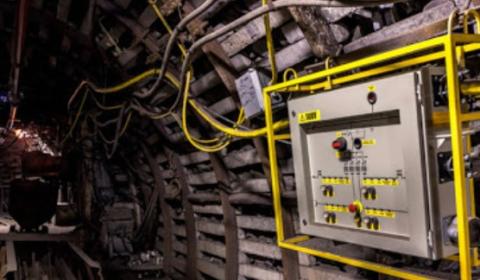
Industrial electrical systems in heavy-load facilities cannot afford unexpected downtime. When a power distribution circuit breaker begins to deteriorate, it transforms from a critical safety asset into a dangerous operational liability. Many plant managers only recognize the damage after repeated production halts, leaving the entire facility exposed to catastrophic fault currents.
Key Takeaways
- Track thermal signatures, strange humming noises, and frequent nuisance trips to catch internal breaker degradation before total system failure occurs.
- Expect gradual component wear from continuous load stress, dust infiltration, and environmental humidity inside industrial enclosures.
- Prioritize immediate replacement over short-term contact repairs when electrical testing reveals erratic trip times or high contact resistance.
- Rely on proactive infrastructure updates to slash emergency maintenance costs and secure predictable facility runtime.
What Are the Early Signs Your Power Distribution Circuit Breaker Needs Replacement?
Early indicators of mechanical or electrical degradation in your power distribution circuit breaker are usually subtle, starting with intermittent nuisance trips under standard operating loads or minor delays during manual resets. In heavy industrial environments like processing plants and aggregate mines, constant ambient vibration and fine dust particles accelerate the wear on internal trip units and spring mechanisms. Ignoring these minor performance shifts typically leads to catastrophic failure when a true short-circuit fault occurs.
Operational Warning Signs
- Frequent Nuisance Tripping: Triggers the internal mechanism during normal, steady-state current draws without any downstream fault present.
- Audible Buzzing or Humming: Signals loose internal laminations, loose busbar connections, or a failing magnetic trip coil vibrating under load.
- Equipment Power Fluctuations: Causes brief voltage drops or intermittent supply interruptions in connected heavy machinery during startup cycles.
- Sluggish Reset Mechanisms: Indicates hardened factory grease, internal spring fatigue, or mechanical binding within the operating handle linkage.
Why Does a Power Distribution Circuit Breaker Fail Over Time?
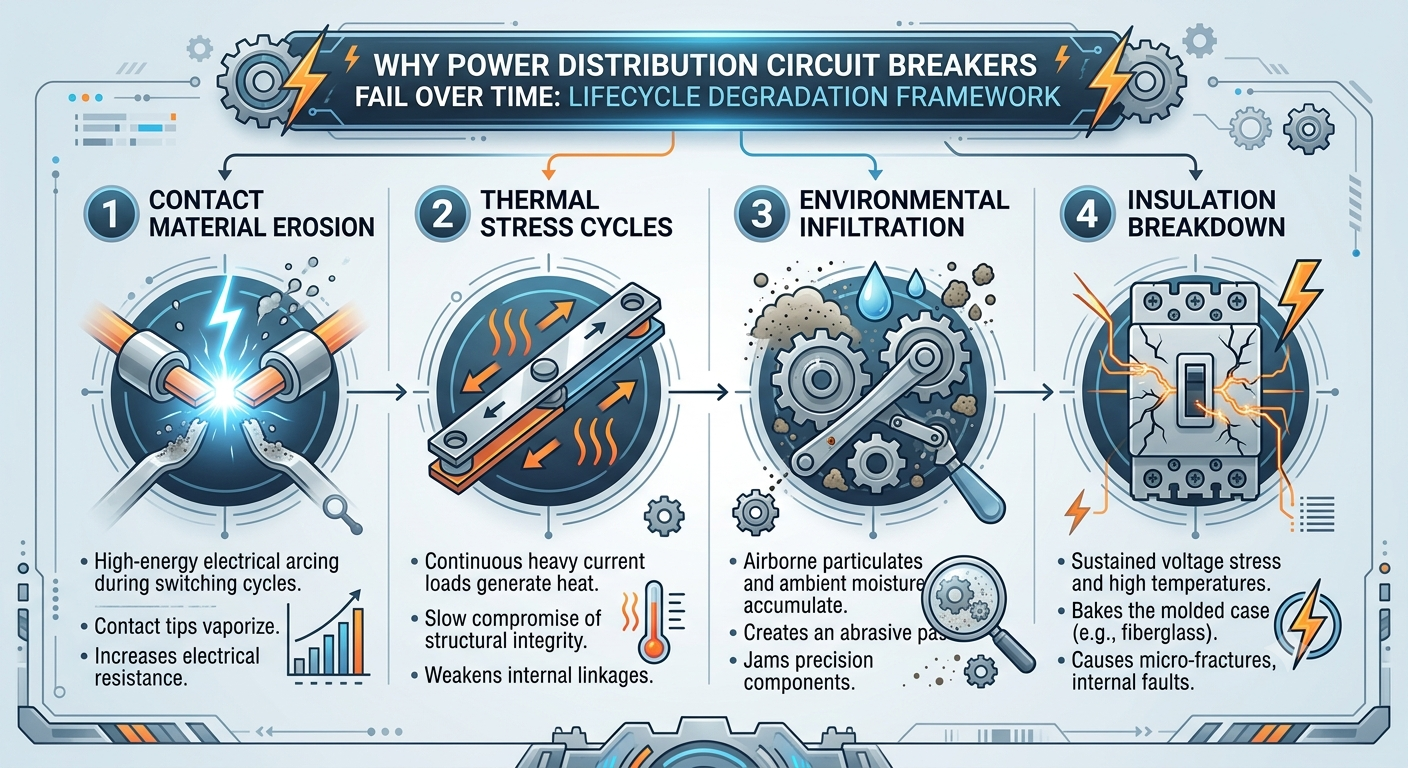
Every power distribution circuit breaker faces inevitable physical degradation driven by high-energy electrical arcing during switching cycles, continuous thermal stress from maximum current loads, and harsh environmental exposure. Over years of service, contact materials erode, arc chutes degrade, and structural insulation breaks down under the punishing conditions of industrial operations.
The Lifecycle Degradation Framework
- Contact Material Erosion: Every load break draws an electrical arc that vaporizes microscopic layers of the silver-tungsten contact tips, steadily increasing electrical resistance.
- Thermal Stress Cycles: Continuous heavy current generation creates expansion and contraction cycles that slowly compromise the structural integrity of internal bimetallic strips and mechanical linkages.
- Environmental Infiltration: Fine airborne particulates and ambient moisture settle into the lubricant coatings, creating an abrasive paste that jams precision moving components.
- Insulation Breakdown: Sustained voltage stress and high operational temperatures bake the fiberglass-reinforced molded cases, causing micro-fractures that permit internal tracking faults.
GET IN TOUCH
In a hurry? Call us at 276-285-3841
How Can You Tell If an Electrical Breaker Is Unsafe for Production?
A physically compromised electrical breaker presents severe hazards, immediately recognizable by distinct operational red flags such as localized enclosure discoloration, scorch marks around the line or load terminals, and persistent thermal signatures above normal operating limits. When internal mechanical components bind, the device loses its ability to clear high-current faults fast enough, creating an active arc-flash hazard for maintenance technicians working near the switchgear.
Critical Field Hazards
- Visible Enclosure Damage: Look for hairline fractures, warping, or blistering on the molded-case frame indicating extreme internal heat buildup.
- Thermal Discoloration: Inspect the primary copper stabs and cable lugs for dark blue or black oxidation caused by localized high-resistance connections.
- Acoustic Anomalies: Listen for sharp crackling, popping, or frying noises that confirm continuous low-level internal tracking or active electrical arcing.
- Terminal Corrosion: Check for white or green oxidation crusts that freeze mechanical fasteners and drive up contact resistance values.
How Do Factory Breakers Compare to Aging Field Units?
|
|
|
|
|
|
|
|
|
|
|
|
|
|
|
|
When Should You Choose Full Replacement Over Temporary Repairs?
Complete replacement is the only safe option when electrical testing yields high contact resistance, slow clearing speeds, or when the cost of sourcing obsolete internal components approaches the price of modern replacement options. While field adjustments can resolve simple external linkage binding, they cannot reverse internal arc-chute damage or restore worn contact material to original specifications.
Technical Replacement Criteria
- Contact Resistance Thresholds: Exceeding manufacturer specifications by more than 50% during micro-ohmmeter testing confirms irreversible contact erosion.
- Erratic Primary Injection Results: Failing to trip within the specified time-current curve parameters during high-current simulation testing.
- Structural Case Compromise: Discovering any carbon tracking paths across the phase barriers or structural cracking in the molded housing material.
- Escalating Support Costs: Spending more on specialized field service technicians and obsolete replacement parts than a modern unit retrofill costs.
How Does Modern Infrastructure Design Secure Plant Uptime?
To protect downstream motors, transformers, and distribution panels properly, electrical teams must implement a structured modernization approach rather than waiting for components to fail under load.
System Protection
- Arc-Flash Mitigation: Upgrading to fast-acting modern designs reduces incident energy levels, drastically lowering safety risks for front-line field electricians.
- Coordination Selectivity: Selecting modern trip units allows precise timing adjustments, ensuring only the local branch breaker clears a fault while main feeder units stay online.
Operational Reliability
- Environmental Sealing: Installing new units within correctly rated enclosures locks out abrasive dusts and ambient moisture that compromise old mechanical linkages.
- Digital Telemetry Integration: Utilizing integrated current monitoring provides continuous operational data, highlighting load imbalances before they cause a production shutdown.
Field Observations from the Plant Floor
Many operations teams treat power distribution breakers like light switches—if the handle stays up, they assume everything is fine. The reality on the ground is much more volatile. Inside that molded case, dried-out factory grease can easily add two or three cycles to a breaker's mechanical response time during a fault. In a high-energy industrial setting, those extra milliseconds are the exact difference between a routine trip and a catastrophic arc-flash event that tears through an entire switchgear lineup.
Real-World Case Studies in Heavy Industry
Case Study: Mid-Atlantic Aggregates Plant
- The Situation: A primary aggregate processing facility experienced intermittent, unexplained voltage drops on a massive 600-horsepower jaw crusher circuit during heavy morning restarts.
- The Diagnostic: Infrared thermography scans revealed an isolated terminal temperature spike exceeding 115°C on the main distribution panel board, far above normal operating parameters.
- The Action: Technicians pulled the line-side power distribution circuit breaker and discovered severe carbon tracking across the internal phase barriers alongside deeply pitted contacts.
- The Outcome: Replacing the degraded unit with a modern, factory-calibrated alternative permanently stabilized operating voltage, eliminating nuisance trips and securing reliable production uptime.
Case Study: Deep Mine Ventilation System
- The Situation: An underground coal mining operation noted a sluggish mechanical response whenever technicians attempted to cycle an aging main ventilation fan breaker for scheduled maintenance.
- The Diagnostic: Time-travel analysis during routine primary injection testing proved the internal spring mechanism was delaying contact separation by over 80 milliseconds.
- The Action: The maintenance team immediately condemned the weak unit, choosing to install a high-durability replacement engineered specifically for severe industrial load demands.
- The Outcome: The new breaker dropped, clearing speeds back within nominal factory limits, keeping the critical life-support ventilation infrastructure safe from extended electrical outages.
GET IN TOUCH
In a hurry? Call us at 276-285-3841
Action Plan for Industrial Power Infrastructure
When your electrical distribution infrastructure shows signs of advanced thermal stress or erratic mechanical operation, ignoring the data raises your operational risk every day. Becker Mining USA delivers heavy-duty power distribution solutions engineered to maintain stable protection under the most demanding industrial work conditions. Reach out to our engineering team at Call Becker to schedule a comprehensive system evaluation and secure a dependable, high-performance power distribution circuit breaker replacement tailored directly to your plant's operational demands.
Frequently Asked Questions
Q: What is the typical operational lifespan of a heavy-duty industrial breaker?
A: Industrial circuit breakers generally provide reliable protection for 10 to 30 years. However, this window shrinks rapidly if the device operates under continuous heavy loads, handles frequent fault interruptions, or sits in high-vibration mining or manufacturing environments.
Q: What causes a breaker to trip frequently when downstream loads seem normal?
A: Frequent nuisance tripping usually stems from internal mechanical wear, such as a weakened bi-metallic strip or an out-of-calibration electronic trip unit. It can also point to high internal contact resistance that generates localized heat inside the breaker housing itself.
Q: Is it safe to field-repair pitted contacts or cracked molded cases?
A: No. Attempting to grind down pitted contacts or patch structural cracks compromises the mechanical alignment and dielectric strength of the device. Internal component damage always requires a complete unit replacement to ensure reliable short-circuit clearing performance.
Q: How often should industrial power distribution equipment undergo electrical testing?
A: Facilities should perform visual and thermal inspections at least once a year. Comprehensive electrical testing—including contact resistance and primary injection verification—should happen every 2 to 3 years in standard environments, and annually in high-stress settings like mines.
Q: What are the main operational risks of delaying a necessary breaker upgrade?
A: Postponing replacement exposes your facility to catastrophic arc-flash incidents, severe upstream transformer damage, prolonged unplanned production downtime, and expensive emergency equipment restoration costs if a heavy fault cannot be cleared.
Products We Offer:
- Explosion Proof Equipment
- Transformers
- Arc Guard
- Longwall Electrical Systems
- Capacitor Trip Devices
- Electrical Equipments like capacitor banks, switch houses, junctions, and splice boxes.
Power up your productivity with Becker Mining's ground fault relays - the reliable and efficient solution for all your power distribution needs. Call us today!