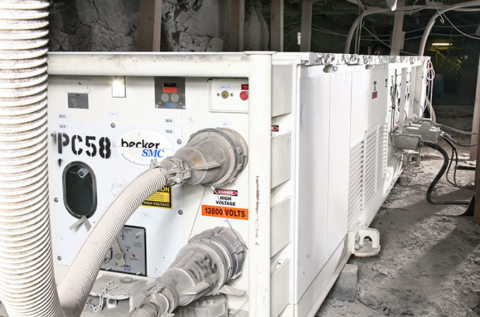
When it comes to choosing metal enclosed capacitor banks, you want to first have a basic insight into how your electrical system works. The configuration that will suit your facility depends upon voltage, reactive power demand, load changes, and installation conditions.
Becker/SMC manufactures electrical controls and power distribution equipment, including metal-enclosed capacitor banks for power factor correction. Collecting your operating data and understanding what you need the equipment to do is always a good place to start. That way, when you are looking to compare proposals, the selection process has a clear focus.
Key Takeaways
- Select capacity using measured demand and power factor across different operating conditions.
- Evaluate harmonics before adding capacitors to systems with nonlinear loads.
- Review switching, protection, and maintenance provisions as part of the complete assembly.
- Match the enclosure to the installation environment.
- Compare the full installed scope and assess potential savings against your utility tariff.
What Are Metal Enclosed Capacitor Banks?
Metal enclosed capacitor banks contain capacitor units within a protective metal housing. Depending on the configuration, the assembly may also include switches, protective devices, controls, and grounding equipment.
In AC power systems, capacitors provide reactive power that helps compensate for inductive loads. The enclosure limits inadvertent contact with energized components and helps protect equipment from environmental exposure. Available configurations include multiple stages that can be switched as operating needs change.
For a buyer, the important question is how those components work together under the facility’s actual operating conditions.
Define the Problem You Want to Solve
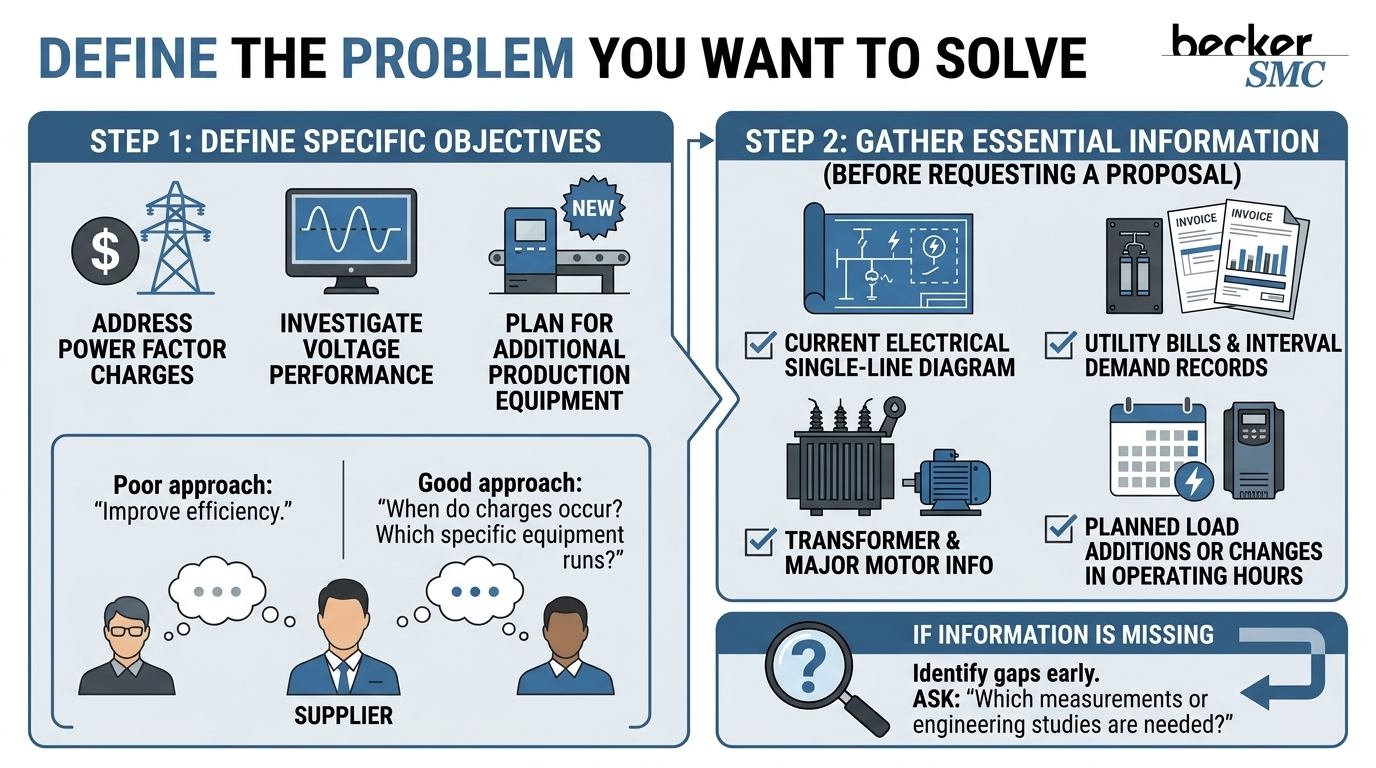
Start with a specific objective. Are you addressing power factor charges, investigating voltage performance, or planning for additional production equipment?
Each concern calls for a slightly different discussion. A request to “improve efficiency” gives a supplier less useful information than a description of when the problem occurs and which equipment is running.
Before requesting a proposal, gather:
- A current electrical single-line diagram.
- Utility bills and available interval demand records.
- Transformer and major motor information.
- Details of existing capacitor banks and variable frequency drives.
- Planned load additions or changes in operating hours.
If information is missing, identify it early. Ask the supplier which measurements or engineering studies are needed before equipment selection can proceed.
GET IN TOUCH
In a hurry? Call us at 276-285-3841
Check Voltage and Electrical Ratings
Confirm the system’s nominal voltage, operating range, and frequency. The selection also needs to account for insulation requirements and the available short-circuit current at the proposed connection point.
These are separate specification items. A bank with an appropriate operating voltage still needs suitable insulation and fault-duty ratings.
Ask for documentation covering the complete assembly and its components. Manufacturer specifications distinguish among voltage, reactive power capacity, basic insulation level, and short-circuit ratings because each addresses a different operating requirement.
A practical review question is: Which system data supports each rating in the proposal? This helps expose assumptions before drawings are approved.
Select Capacity for Normal and Reduced Loads
A capacitor bank’s kVAR rating describes its reactive power capacity. Sizing should reflect measured demand and the intended power factor improvement.
Check reduced-load operation as well as peak production. Excess compensation can produce a leading power factor. A fixed bank may suit a relatively steady requirement, while varying loads may benefit from automatically switched stages.
For example, consider a facility that runs several production lines during the day but only essential equipment overnight. Ask the supplier to explain how the proposed bank responds to both conditions, including its smallest available step.
Evaluate Harmonics Before Adding Capacitors
Variable frequency drives and other nonlinear loads can introduce harmonics. Capacitors may interact with system inductance and create resonance, increasing distortion.
A standard power factor correction bank does not automatically provide harmonic filtering. An engineering assessment may identify the need for a detuned arrangement, a tuned filter, or another approach.
Tell the reviewing engineer about existing compensation equipment, major drives, and alternative supply arrangements. Ask whether the assessment covers planned expansion and the combinations of loads that operate together.
Review Switching and Protection
Capacitor switching can produce inrush currents and voltage transients. The review should consider how often the bank will switch and whether other capacitor stages will already be energized.
Depending on the application, the design may require inrush-limiting reactors, controlled switching, capacitor fusing, or unbalance protection.
Maintenance provisions also matter. Capacitors can retain stored energy after disconnection. Discharge devices, isolation, grounding, and interlocks should form part of the equipment review. An open switch alone does not establish a safe condition for access.
Ask the supplier to explain the protection scheme and provide operating and maintenance documentation with the proposal.
Match the Enclosure to the Site
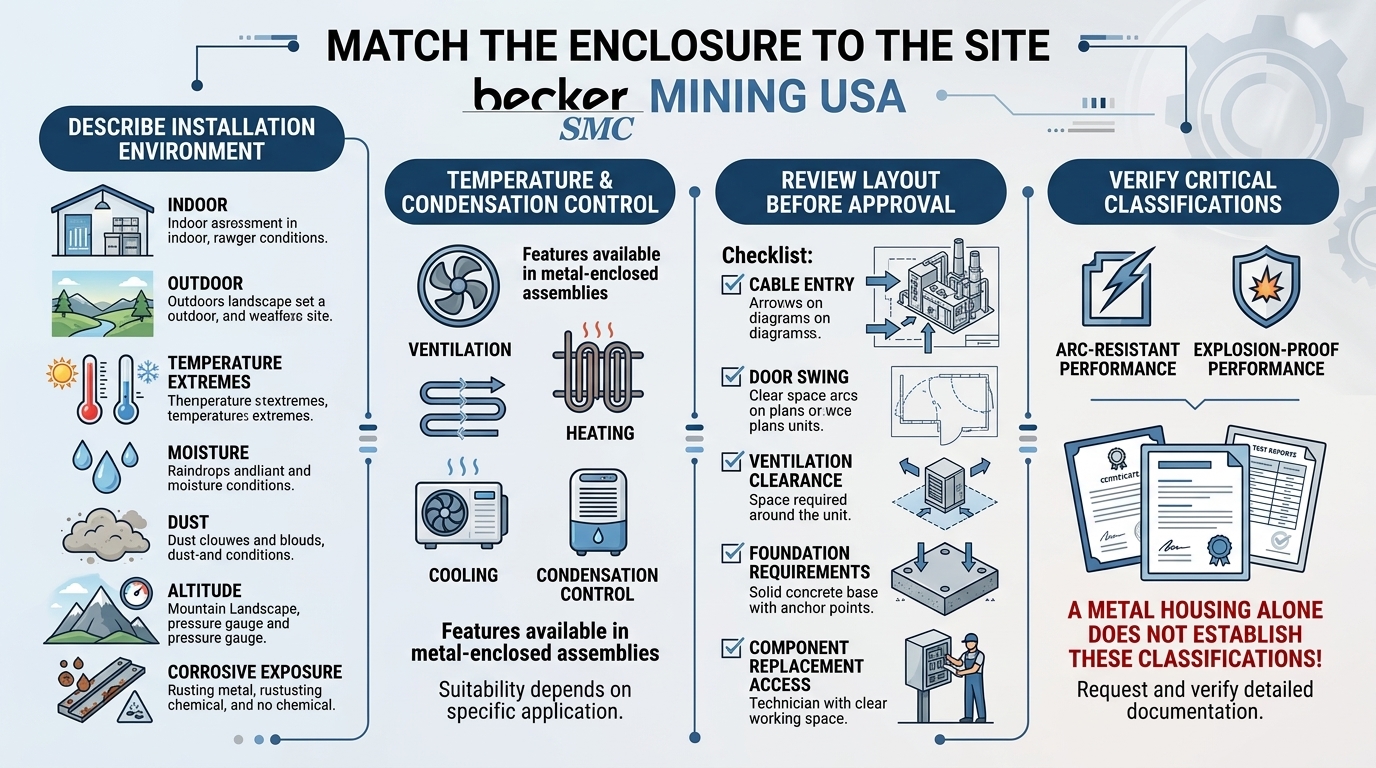
Describe the installation environment in detail. Include indoor or outdoor placement, temperature extremes, moisture, dust, altitude, and corrosive exposure.
Discuss temperature and condensation control alongside enclosure protection. These features may be available within metal-enclosed assemblies, but their suitability depends on the application.
Before approving the layout, review cable entry, door swing, ventilation clearance, foundation requirements, and component replacement access.
Also request documentation for any required arc-resistant or explosion-proof performance. A metal housing alone does not establish either classification.
GET IN TOUCH
In a hurry? Call us at 276-285-3841
Compare the Full Project Scope
Use the same checklist for every proposal so differences are easy to identify.
|
|
|
|
|
|
|
|
|
|
|
|
|
|
|
|
|
|
|
|
|
Request written exclusions. This helps prevent an apparently lower equipment price from obscuring additional installation or commissioning costs.
Discuss Your Capacitor Bank Requirements With Becker/SMC
At Becker/SMC, our capabilities include electrical control systems, power distribution equipment, and custom equipment built around customer specifications. Our electrical-equipment range includes metal enclosed capacitor banks for power factor correction.
Contact our team with your system information and project goals to discuss your capacitor bank requirements.
Frequently Asked Questions
Q: Will a capacitor bank lower our electricity bill?
A: It may reduce applicable power factor or kVA charges. Savings depend on the tariff and operating profile; correction does not directly reduce the real power required by the process.
Q: Is an automatic bank always the better choice?
A: No. Ask the supplier to justify automatic staging using your measured load changes and operating requirements.
Q: Can we select a bank using only its kVAR rating?
A: No. Voltage, fault duty, harmonics, controls, protection, and installation conditions also need review.
Q: What should we provide with an inquiry?
A: Start with your single-line diagram, system ratings, demand records, major-load details, and site conditions.
Products We Offer:
- Explosion Proof Equipment
- Transformers
- Arc Guard
- Longwall Electrical Systems
- Capacitor Trip Devices
- Electrical Equipments like capacitor banks, switch houses, junctions, and splice boxes.
Power up your productivity with Becker Mining's ground fault relays - the reliable and efficient solution for all your power distribution needs. Call us today!