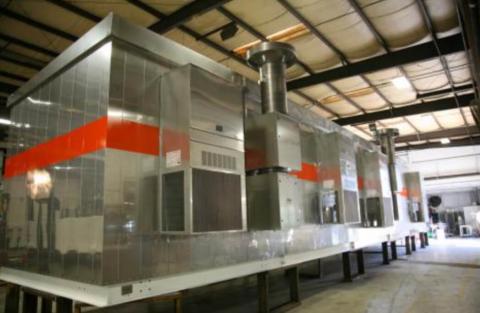
When a mine needs a new electrical building, the first decision is how to build it. One path is a stick-built control room put up on site. The other is a modular e house built in a factory and shipped ready to connect. At Becker Mining, we build modular units, and we think the honest answer depends on schedule, site conditions and how long the building needs to stay put.
Key Takeaways
- A modular e house moves most labor off site, so building work and site prep can happen at the same time.
- Stick-built rooms can make sense for very large, permanent buildings with easy site access.
- Remote sites, short seasons and tight schedules usually favor modular.
- Relocation and expansion are much simpler with a modular design.
Where Does the Schedule Difference Come From?
With a stick-built room, foundations, framing, electrical install and testing happen one after another at the mine. Weather and crew availability slow each step. With a modular e house, the building and gear are assembled and tested in the factory while the pad is poured at the mine. When the unit arrives, crews set it, ground it and connect cables.
What Drives the Total Cost?
We do not quote numbers here, because every project is different, but these are the factors that move the total in either direction:
|
|
|
|
|
|
|
|
|
|
|
|
|
|
|
|
|
|
|
|
|
|
|
|
Remote mines often see the biggest gap, because every day of on-site labor carries travel and support costs.

GET IN TOUCH
In a hurry? Call us at 276-285-3841
When Does Stick-Built Still Win?
Very large buildings that exceed shipping limits, or permanent rooms built next to an existing structure, can favor a site-built approach. Even then, many owners use a hybrid: a modular e house for the switchgear and a simple shell for storage.
Learn more about Becker e houses, our prefabricated containerized e houses for mining, and why e houses matter in underground mining.
Why Does Factory Wiring Shorten Commissioning?
Commissioning is the stage where every circuit is tested and energized for the first time. In a stick-built electrical room, that work often reveals wiring errors made in the field, missing labels and terminals that were never torqued. Each problem has to be traced, corrected and retested. A modular e house arrives with that work largely complete, because the same tests were run under factory conditions.
Factory crews work with drawings at a bench, good lighting and the right tools close at hand. They label wires as they install them and check torque on every lug. Point-to-point testing confirms that each wire lands where the drawings say it should. When the building reaches the mine, commissioning focuses on the field cables that connect it to the substation, the motors and the mine's control network.
How Does Weather Affect the Two Approaches?
Field construction depends on the season and the site. Rain, snow, heat and wind slow work on an open building, and electrical crews cannot pull cable or terminate wires in wet conditions. At remote mines, crews may also lose days to road closures or travel limits. Those delays stack up because each trade waits for the one before it.
A modular e house is built indoors while site crews prepare the foundation and cable routes outdoors. The two schedules run side by side. When the building ships, the pad is ready, and setting it can take days where field construction would have taken weeks. This parallel path is the main source of the schedule difference most projects see. It also reduces the number of workers who must travel to and stay at a remote site, since much of the labor happens at the factory. Fewer people on site for a shorter time means less exposure to site hazards and simpler logistics for housing and transport.
How Does a Modular Building Handle Future Changes?
Mines change as the ore body moves. New conveyors, pumps and ventilation fans add load over the life of a site. A modular e house can be designed with spare breaker spaces, extra transformer capacity and room in the cable trays for later circuits. Some owners specify a blank wall section that can be removed to bolt on another module later.
Because the building is a self-contained unit, it can also move. When a section of the mine closes, the e house can be disconnected, lifted onto trucks and set up again at a new location. A stick-built room stays where it was built. For sites with a short mine life or a series of small pits, that mobility often matters as much as the original schedule.

GET IN TOUCH
In a hurry? Call us at 276-285-3841
What Should the Specification Include?
A clear specification keeps both approaches comparable. It lists the incoming voltage, the loads to be served, the environmental conditions at the site, the codes that apply and the testing the owner wants to witness. It also states who supplies the foundation, the field cables and the commissioning crew. Becker's engineers can review that scope with a mine's project team so the modular e house is designed around how the site will actually operate.
Get a Project Estimate
Call Becker Mining or request a quote. Share your site location, load list and schedule, and we will walk through whether a modular e house fits.
Frequently Asked Questions
Q: Is a modular e house always cheaper?
A: Not always. It usually saves site labor and time, but shipping limits and building size also matter. We review both paths with you.
Q: Can a modular e house be expanded later?
A: Yes. Modules can be added or relocated as the mine changes.
Q: How is it shipped?
A: In one piece or in modules, depending on size and road limits.
Q: Does a modular e house need a special foundation?
A: It needs a level pad ready when the unit arrives. Site crews can pour that pad at the mine while the building is assembled and tested in the factory, which is a big part of the schedule savings.
Products We Offer:
- Explosion Proof Equipment
- Transformers
- Arc Guard
- Longwall Electrical Systems
- Capacitor Trip Devices
- Electrical Equipments like capacitor banks, switch houses, junctions, and splice boxes.
Power up your productivity with Becker Mining's ground fault relays - the reliable and efficient solution for all your power distribution needs. Call us today!